

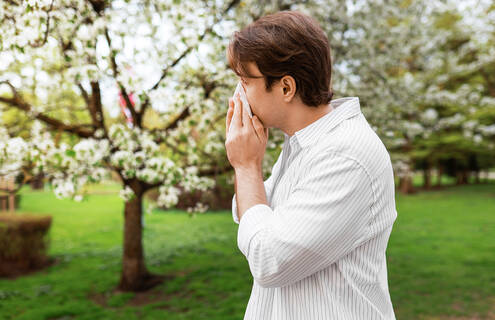
“Pollen this year is worse than ever.” That’s what Dartmouth Hitchcock Medical Center (DHMC) Allergy and Clinical Immunology Specialist Erin L. Reigh, MD, MS, has heard from patients year after year.
Now, thanks to a pollen counting station she set up with the National Allergy Bureau (NAB) and the American Academy of Asthma Immunology, you can look up the levels of pollen in your area and find out how bad the pollen really is.
And while this April and May pollen counts are high, they are actually not worse than last year during this time, says Reigh’s DHMC colleague Alexander Zajack, MD, who collects the pollen weekly from the DHMC pollen counting station that sits atop the roof of the hospital.
Here are some of Zajack’s and Reigh’s takeaways on pollen in the region and what to know in order to better manage your allergies.
You can get local pollen counts
Before Reigh set up the pollen counter in the fall of 2024, there was not a way to know how bad the pollen was locally.
“Anecdotally, people would say things like, ‘Pollens are really bad this year, much worse this year than last’ year.' Or, ‘the pollen came out earlier than usual.’ But we really didn't know if that was true. The closest certified pollen counters were over a hundred miles away. So, I wanted to find out whether they are getting worse every year and what exactly is out in our area,” Reigh explains.
So, Reigh set up the pollen-counting station and started collecting data.
This year, Zajack took over the weekly pollen collection, recording the pollen counts based on 24-hour increments. At the end of every week, Zajack then uploads the collected data to the National Allergy Bureau that puts the data on the American College of Allergy and Immunology website.
“That allows patients to have access through My NAB to the most up-to-date counts that we can provide,” says Zajack.
Pollen varies by season
As a general rule, spring brings tree pollen.
Grass dominates the summer pollen season, which begins in late May and extends into July.
The fall pollen season, which usually starts in late August and lasts until the first freeze, comes mostly from weeds.
This past spring had a lot of cottonwood pollen
While overall pollen levels were similar to last year, a few trees stood out.
Zajack says this spring produced a very high count of cottonwood pollen. Oak pollen was second. Pollens from juniper or cedar, as well as maple, were also significant.
Birch rounded out the top list of five.
Tree pollen comes in waves
“What we found in the spring is that different trees will make a huge spike in pollen for a couple of days, and then the levels are lower. And we saw mostly very similar patterns this year as last,” says Reigh.
But if you have allergies to one of the tree pollens, your suffering might not be limited to their spikes.
“People can definitely have symptoms for weeks once their allergies have started to flare up,” says Reigh.
Some seasonal pollens are more allergenic than others
“Certainly, birch and oak are some of the most allergenic tree pollens in the spring. Cottonwood is not quite as allergenic,” says Reigh.
In the summer, the northern grasses can be triggering. “Orchard and Timothy are the two major ones, and they tend to be cross-reactive with each other, meaning generally, folks who are sensitive to one are probably sensitive to both,” says Zajack.
In the fall, ragweed tends to be the most allergenic.
Don’t base your pollen assumptions on what you see outside
"The more allergenic types of tree pollen tend to be smaller, make it further down your airways, and to come earlier in the spring,” Reigh says.
Conversely, pine–which has large, bright yellow particles–tends not to be as allergenic, though people often assume they are reacting to it because they can see it. "Pine isn't hanging in the air as long as some of the other pollens, and oftentimes when we test people, they're negative to pine and wildly positive to birch, oak and maple," she says.
Pine is not the only pollen that people make false assumptions about.
“Another one that gets a bad rap is goldenrod,” Reigh explains. “So, in the fall, when all the goldenrod is blooming, and people are feeling miserable, people are always saying, ‘It's the goldenrod' because that’s what they see. But actually, goldenrod is another pollen that isn't very allergenic, and it doesn't tend to float a lot in the air, either. It's mostly insects that move that pollen about. What's really bothering people is ragweed,” she says.
Also, while a downpour can help clear pollen, a rain drizzle is more effective.
“It’s called ‘scrubbing the air,’” Reign says.
You might not be reacting to pollen at all
According to the Asthma and Allergy Foundation of America, pollen symptoms include:
- Runny nose (also known as rhinorrhea – usually a clear, thin nasal discharge)
- Stuffy nose (due to blockage or nasal congestion)
- Postnasal drip (mucus runs from the back of your nose down your throat)
- Sneezing
- Itchy nose, eyes, ears, and mouth
- Red and watery eyes
- Swelling around the eyes
- Shortness of breath, coughing, and/or wheezing
But you can also have reactions to other environmental allergens that are not pollen. An allergy to mold, for example, is very common.
“Anytime the air is moist and not frozen, you're also seeing molds. So, if someone has seasonal symptoms and there's molds [present], that could be a trigger for people, too,” says Reigh.
If you are having allergy-type symptoms, you could also have something called vasomotor or nonallergic rhinitis. It is not an allergy but it mimics one. And nonallergic rhinitis is not effectively treated by over-the-counter allergy medications.
“It’s essentially the nerve endings in the nose becoming a little overly sensitive to things in the environment,” explains Reigh. “Oftentimes we see an adult who comes in and says, ‘I just started having symptoms in my thirties or in my forties.’ Those patients are more likely to have this nonallergic rhinitis. That’s because while you can develop allergies at any age, allergies do usually start before the age of 20. And this nonallergic rhinitis has a lot of different triggers,” says Reigh.
What to do if you think you have allergies
Zajack says if you have allergies, you might want to consider going about your day a little differently. Modifications include:
- Showering and changing clothes more frequently to remove allergens from skin and fabric.
- Avoiding going out in early mornings. Pollen levels are highest immediately after sunrise, so try to stay indoors during the early morning to minimize exposure.
- Keeping your windows closed. Closing your windows and regularly changing air filters in your home will help your home circulate pollen-free air throughout the year.
- Running the vacuum, which can help get rid of dust mites that can thrive in summer months due to heat and humidity.
- Subscribing to the pollen counter at My NAB, to check local pollen counts.
- Trying an over-the-counter allergy medication. There are many over-the-counter medications. These can help alleviate your symptoms, especially so-called second-generation medications. Learn about allergy medicines in this article< by Dartmouth Health.
- If you’re still suffering, set up an appointment with an allergist If over-the-counter medications aren’t working, something else could be going on. When people aren't responding to traditional therapies, that's a good reason to see an allergist.
If you have asthma along with your allergies, consult with a doctor or allergist. "There is certainly a smaller percentage of the population who have an allergic component to their asthma. It can be concerning,” says Zajack.
Reigh agrees. “If someone is developing asthma or asthma-like symptoms, such as wheezing or shortness of breath with pollens, they should see an allergist, because there are a lot of other treatments for that. These are very specialized but highly effective, and they can really improve your quality of life and outcomes for people with asthma who have allergic triggers.”
For more on the DHMC pollen counter, read “Monitoring pollen close to home”.
Check out this article about Benadryl and other allergy medications.
Subscribe to My NAB on the American Academy of Asthma Immunology website for information about local pollen counts.