
More people are turning to hyperbaric oxygen chambers to try to address a growing number of conditions.
It is no surprise.
The hyperbaric oxygen (HBO2) you get in pressurized chambers at hyperbaric medicine clinics has long been shown to help heal compromised tissue that is otherwise having difficulty repairing itself.
Hyperbaric medicine treatment is also showing increased promise for use in new applications, including ulcerative colitis, Crohn’s disease, and some chronic infections. There is even the possibility it could one day help treat Alzheimer’s disease.
But because of that promise, many unaccredited hyperbaric clinics and pressurized chambers are popping up, providing unproven treatment for all sorts of conditions. Spas, health clubs, and longevity biohackers are promoting their so-called hyperbaric chambers for general wellness, anti-aging, and athletic recovery.
You need to be vigilant, stresses Jay C. Buckey Jr, MD, section chief of Hyperbaric Medicine at Dartmouth Hitchcock Medical Center (DHMC).
“It’s important to make sure you go to an accredited hyperbaric medical clinic and get 100% high-pressure oxygen, not a gas mixture with only some degree of elevated oxygen from an unaccredited, stand-alone, commercial organization,” he says. “The treatment needs to be safe and to have evidence that it is effective.”
Here is how HBO2 works, why you need to go to an accredited hyperbaric medical clinic, and how the treatment might help you now and one day in the future.
What is hyperbaric medicine?
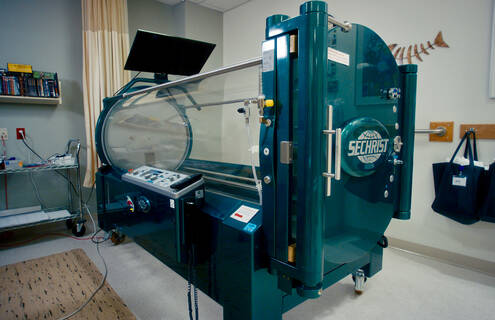
Hyperbaric medicine uses a high-pressure oxygen chamber to increase the amount of oxygen you breathe.
By increasing the atmospheric pressure in that chamber, your body is able to benefit from much higher levels of oxygen than it can at normal pressure.
Buckey explains: “In normal situations, 21% of the air around you is oxygen. But if we filled the room with oxygen, it would be 100% oxygen around you and every time you breathe you would get more oxygen in the body. Then, if we pressurized that room, we would be getting 100% oxygen under pressure, and this would greatly increase the amount of oxygen in the blood.”
That hyperbaric oxygen then helps repair damaged tissue and organs, while also allowing white blood cells to fight infection more effectively.
“Where there are areas that are not getting enough oxygen, this inhaled oxygen helps the affected area,” Buckey says.
For which conditions has HBO2 been proven effective?
The first clinical uses of hyperbaric oxygen were to treat decompression sickness, which can occur in scuba divers.
Applications have since grown.
For Caroline Alley, the hyperbaric treatment from the high-pressure oxygen chamber at DHMC saved her from losing her feet when severe frostbite had cut off oxygen supply to her blood vessels.
“She would go down to the hyperbaric chamber, and her feet were gray. And she'd come back, and they were pink,” says Caroline's father, Max Alley, of her seven days of hyperbaric treatment.
And while many people now think of hyperbaric oxygen treatment as primarily for wound care, Buckey says that the most common reason for hyperbaric treatment at Dartmouth Health is for delayed radiation injury. Treating delayed radiation injury accounts for some 57% of the treatments at Dartmouth Health.
“There are many other conditions we treat, too,” Buckey points out. “Some are conditions where getting oxygen into an area is important right away, such as severe anemia, gangrene, compromised skin flaps and grafts, central retinal artery occlusion, or carbon monoxide poisoning. And then there are those conditions, such as delayed radiation injury or sudden hearing loss, where daily pulses of oxygen in the chamber gradually lead to improvement.”
In total, the U.S. Food and Drug Administration (FDA) and the Undersea and Hyperbaric Medical Society (UHMS), a nonprofit considered the primary source for scientific information on the subject, now recognize 15 medical conditions for which HBO2 is an approved, evidence-based treatment.
These conditions are:
- Delayed radiation injury
- Diabetic wounds of the lower extremities
- Skin grafts and flaps
- Some types of life-threatening soft tissue infections
- Gas gangrene
- Air and gas embolisms
- Decompression sickness ("the bends")
- Carbon monoxide poisoning
- Injuries and conditions that result in oxygen-starved tissues such as crush injuries and compartment syndrome
- Brain abscesses or infections
- Severe thermal burns
- Central retinal artery occlusion (CRAO), which can lead to permanent vision loss
- Sudden hearing loss known as idiopathic (unknown cause) sudden sensorineural hearing loss (ISSHL)
- Avascular necrosis, where bone tissue dies because it’s not getting enough blood flow
Sudden hearing loss is one of the newer treatments that is FDA-approved and one that Buckey himself researched.
Why you need to make sure your treatment is high-pressure with 100% oxygen
It’s important that the pressurized treatment you receive is 100% oxygen, says Buckey.
Some stand-alone clinics that advertise as hyperbaric centers are not providing true hyperbaric oxygen. Instead, they are providing a so-called “oxygen-enriched” gas mixture at a slightly elevated pressure.
“This is not effective and can be dangerous,” he says.
Buckey also warns strongly against people attempting to create their own oxygen chambers at home.
“Doing your own hyperbaric oxygen treatments at home is just a really, really bad idea,” he says. “The biggest risk is fire. We spend a lot of time keeping that risk very low and it's extremely rare to have a fire in a hyperbaric chamber if you follow the appropriate safety procedures. We're very compulsive about safety. We make sure that nothing ever goes into that chamber that might be an ignition source.”
You can search for UHMS-accredited clinical hyperbaric medicine facilities at the UHMS web site.
What does treatment typically entail?
During HBO2 sessions, patients lie down on a bed that slides into a pressurized tube or, in some clinics, a large chamber. Each session usually lasts an hour or two. Treatments can range from three to 80 sessions based on the patient’s condition.
"By and large, treatments are five days a week, weekends off. It's the daily pulse of oxygen every day that has a cumulative effect,” says Buckey. “They get the healing process going and then eventually you start to see the effect. But it can take a while. It’s a slow cooker of medical therapies.”
Most people, Buckey says, aren’t bothered by the treatment, unless they have a fear of enclosed spaces. The chamber is see-through acrylic, which helps.
But the change of pressure doesn’t go unnoticed.
“At the start of each session, you may feel a pressure sensation in your ears that is similar to what you experience when you are coming in for a landing in an airplane. It’s a result of the atmospheric pressure increasing in the chamber,” he says.
In addition, treatment is generally safe when done in medical settings where healthcare teams closely monitor the patient and the room.
“The treatment can raise your blood pressure slightly. We notice that when people come out of the chamber,” he says. So, the healthcare team keeps an eye on that, too.
Risks associated with hyperbaric oxygen treatments at hyperbaric medicine clinics are generally very low.
“Maybe between one in a thousand or one in ten thousand times somebody can have a seizure due to the high oxygen level. It usually happens at levels higher than what we use. In about 22 years of operation, we've had two seizures," Buckey says. "People also can notice some change in their vision. It either gets better or worse, which is due to a slight change in the shape of the lens. But that's something that gradually goes back to where it was. High oxygen levels can also promote the growth of cataracts.”
Growing evidence to support new treatment applications
While HBO2 has long been used, its outcomes have historically not been widely tracked. That is why Buckey worked to establish a registry of hyperbaric patient outcome data, which has grown to be an international registry with 33 centers and more than 15,000 entries.
Buckey says because of the registry, there is growing evidence to support the expanded use of HBO2 in new applications.
“When I first got started in hyperbaric medicine, I was very frustrated by the level of evidence that existed. For programs like ours, with two chambers that people visit maybe 20 or 40 times, we couldn’t put together a strong evidence-based case for treatment effectiveness because we didn’t have enough people and cases. Now, we can start to look at outcomes from patients from all over the country and even the world. That's been very useful,” he says.
For example, his colleague Rachel A. Moses. MD, MPH, was interested in the outcomes of hyperbaric oxygen treatment for patients with radiation cystitis.
Moses, Buckey and others were able to use registry data to analyze patient outcomes from more than 400 cases following HBO2 for radiation cystitis.
Together with urology resident Stephen A. Harrington, MD, Moses has now done this review on the role of hyperbaric oxygen in treating radiation cystitis, and Moses continues to do research, including measuring inflammatory markers in the urine of people with radiation cystitis to see if she can uncover the mechanism for how hyperbaric oxygen works there.
What the future holds for hyperbaric medicine
Evidencing the effectiveness of HBO2 in treating conditions requires persistence and patience, says Buckey.
For example, Buckey and Dartmouth Health colleague Corey A. Siegel MD, MS, often talked about how hyperbaric oxygen might have a role in ulcerative colitis.
Seigel then got a funded grant to look at the question, which resulted in a small positive trial on the effect of hyperbaric oxygen treatment for severe ulcerative colitis, but a larger trial still needs to be done to get a definitive answer as to how effective hyperbaric oxygen is for ulcerative colitis.
When enough evidence shows that HBO2 can treat new conditions like these, not only is the FDA more likely to approve these applications, but insurance companies are more likely to approve reimbursement for treatment.
“There are other treatments where hyperbaric oxygen makes sense, but it hasn't been studied in detail and there just haven't been enough cases put together to show a benefit. That's something that we've been trying to address with our registry,” Buckey says.
“For example, there’s some indication that it might be good for certain kinds of venous ulcers. But we just don’t have the data to support its use,” he says.
Another possible application is for persistent Long COVID symptoms, but the supporting data remains very limited.
And what about Alzheimer’s?
Buckey says that HBO2 might also hold promise for treating Alzheimer's, and some studies have suggested that possibility.
Theoretically, it makes sense, Buckey says. “If you give hyperbaric oxygen treatments, you might be able to improve the oxygen level and reduce inflammation in the brain. It’s worth looking into,” he concludes.