


What does coordinated care mean?
For a 32-year-old man who had Fournier’s Gangrene, it meant his life.
On a visit to the Cheshire Medical Center, he learned he had the rare, rapidly progressing bacterial infection that could lead to death within days—or even hours—if left untreated.
Immediately, a nurse called Dartmouth Health’s Capacity Coordination Center (CCC) to schedule him for surgery at Dartmouth Hitchcock Medical Center (DHMC)
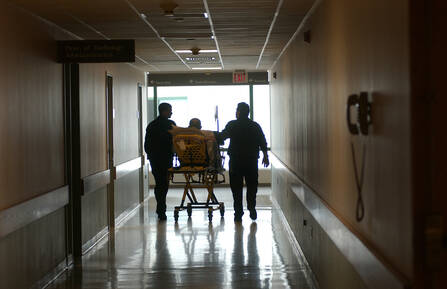
Then, DHART (Dartmouth Hitchcock Advance Response Team) transported him to their OR before he was eventually transferred back to Cheshire for follow-up care, in addition to his continued treatment at DHMC.
All was quarterbacked by the CCC, which organizes patient transfers across Dartmouth Health hospitals and clinics, and last year opened up approximately 4,000 needed patient beds at DHMC.
For patients, the result of the CCC's coordinated care has been significant.
"Denial rates of people being transferred are way down, even while admission calls have increased. We only had to say 'no' to two percent of patient placement requests, thanks largely to the CCC," says Dartmouth Health's Director, Strategic Plans & Operations, Luca Boi, who is responsible for supporting the development and implementation of strategic, operational, and quality initiatives for this department.

What is coordinated care?
“The right patient, at the right time, in the right place.”
That’s how System Vice President, Care Coordination, Jessica Ryan, MSN, RN, CPHQ, explains coordinated care.
To make that care happen, the CCC answers constant calls not only from Dartmouth Health members but also from acute care facilities across northern New England whose patients need specialist care.
Their efforts require the collaboration of many departments, including Dartmouth Health's Transfer Center, Patient Placement, Care Management, and System Transportation through DHART.
In addition, Dartmouth Health’s System Staffing Office now maintains a pool of clinical employees trained to be deployed to member hospitals, and they are exploring expanding the pool of hospital operations support staff as well.
“We do a triage based on clinical information to determine what type of facility or services the patient needs,” Ryan says, noting that once a facility with space has been identified, staff must then consult attending providers.
To help them do their job, the center uses large monitors that track open beds, hospital admissions, and DHART transport.
That data, together with predictive analytics and ongoing communication with health providers, helps the center support emergency care and transfers 24 hours a day, seven days a week.
Why coordinated care matters
“It’s likened a lot to (NASA’s) Mission Control,” Ryan says of the CCC. “This is where we level-set capacity across the system.”
This ability of the CCC to level-set—or make sure everyone is on the same page when it comes to meeting each patient’s unique need across the system—is increasingly important given new challenges in the healthcare landscape.

Among these challenges are rising emergency department visits, hospital closures, and difficulty securing hospital transfers in some regions of the country.
Coordinated care means patients get the care they need despite these challenges.
The people who coordinate care
But the actual coordination of that care requires dedicated effort.
For the men and women at the CCC, coordinating care means exemplifying extraordinary grace under pressure, says Ryan. "They are truly heroic,” she says.
Among those men and women is Eileen A. Hays-Bonaccolto, DNP, RN, CNML, who began working as a nurse at DHMC 17 years ago before moving into leadership.
In addition to overseeing the Center, she now gives presentations to nurse residents about the work of the CCC, which she compares to putting together a Tetris puzzle.
For Zarah Balardo, RN, a case manager with the regional triage team, coordinating care means using her nursing skills to read patients' charts and determine whether they should remain at DHMC, and, if appropriate, where they are best served to be transferred, preferably closer to home.

"It’s rewarding every time we are able to transfer patients to appropriate care closer to home, and to allocate needed beds at DHMC to other patients across the region," she explains.
For Fyiona S. Miller, RN, a capacity coordinator specialist who looks at patient flow across the various member hospitals of Dartmouth Health, coordinating care means using her critical-thinking skills, as well as problem-solving and time-management abilities.
And for Elisabeth S. Souther, MD, system associate medical director of Care Coordination, coordinating care has meant developing the Acute to Acute program for patients requiring ongoing acute care, and continues to mean collaborating with hospitalists to ensure that patients get the right care, at the right time, and at the right place.
The future of coordinated care
Even with the CCC's success in matching patients to beds based on their needs, the importance of their work is not expected to abate.

Observes Colin D. Stack, MD, system medical director of Care Coordination: “This is a national trend. Hospital systems are moving in this direction toward total patient movement, and all of these various modules are combined into a sum that is greater than its parts.”
Stack believes the resulting need to coordinate care brings indisputable benefits to patients.
“There are increased opportunities across the entire care continuum for patients. Patients can access Dartmouth Health in more ways and feel like they are receiving the same level of service," he says.
For Laura Albanese, the benefits are clear.
Her husband received emergency surgery at DHMC for brain trauma several years ago.
Now retired, he continues to receive follow-up care from specialists, including at New London Hospital (NLH), which is closer to home.
“We could not be happier with how we have continued to be connected to great care," she says.