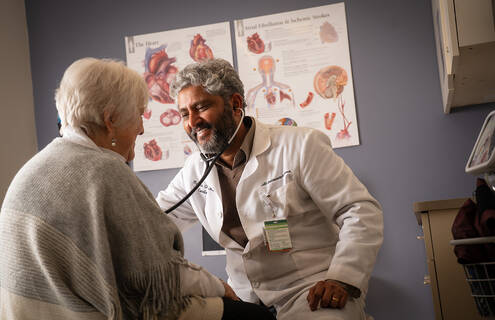
These new options allow doctors to provide more advanced treatments and help patients take an active role in their recovery and long-term health.
Audrey A. DeFusco, MDYou rolled your ankle on a hiking trail or injured your rotator cuff while lifting a heavy piece of furniture.
You might think that a torn ligament or damaged tendon needs surgery. But orthopaedic injuries can often heal without it.
“Not everybody needs surgery,” says Neal B. Goldenberg, MD, a sports medicine physician at Cheshire Medical Center. “There are absolutely ways that we can treat an injury and improve your quality of life.”
Our doctors share new and traditional treatments and which injuries can heal well without surgery.
What are some non-surgical treatments to explore?
“In the past decade, there’s been great progress to give patients more ways to recover and stay active, often without surgery,” says Audrey A. DeFusco, MD, an orthopaedics and sports medicine specialist at Dartmouth Hitchcock Medical Center.
Research shows that nonsurgical treatments can sometimes be just as effective as surgery.
The right treatment depends on your injury. Options like physical therapy, bracing, and home-based activities can be effective, as well as more cutting-edge options like sound-wave treatment and plasma injections.
Sound-wave therapy
Sound-wave treatments use high-energy acoustic waves to help stimulate healing and decrease pain. They can help with bone injuries or painful tendon conditions in the shoulders, elbows, knees, or ankles caused by repetitive use or strain.
“These new options allow doctors to provide more advanced treatments and help patients take an active role in their recovery and long-term health,” DeFusco says.
Platelet-rich plasma injections
Platelet-rich plasma (PRP) injections have grown in popularity as a nonsurgical treatment for certain joint and tendon conditions. A 2023 study found that PRP injections quadrupled between 2010 and early 2020.
The injections use concentrated platelets from your own blood to treat certain joint and tendon conditions, reduce pain, and improve mobility.
“I use PRP more and more these days. In the appropriate patient, PRP can be an effective treatment for arthritis, meniscal tears, ligament, and tendon injuries,” says sports medicine physician Peter M. Loescher, MD, of Alice Peck Day Hospital. “PRP works by stimulating your body’s own healing cascade, and giving those repair and healing cells access to areas with limited blood flow and limited healing potential.”
Subscribe to the Living Better newsletter
Your trusted resource for reliable and up-to-date health and wellness information in the Northeast. Get it delivered to your inbox every other week.
What about physical therapy?
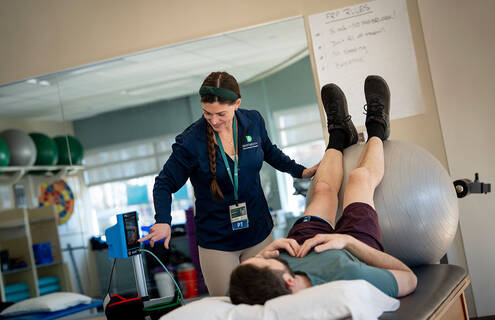
Physical therapy, which uses guided exercises and stretches to improve strength, flexibility, balance, and movement, is a popular option for injuries.
“Physical therapy is about more than recovery. It’s a long-term tool to help you maintain healthy movement and prevent injuries from coming back,” DeFusco says.
Other options include:
- Injections: These include corticosteroid injections to reduce pain and swelling, and hyaluronic acid injections to help lubricate joints.
- Bracing and casting: These supports help stabilize an injured joint or bone so it can heal properly. They are often used for certain fractures, sprains, and ligament injuries.
- Medications: Non-prescription pain relievers or anti-inflammatory drugs can help control pain and swelling.
- Activity modification: Changing or avoiding activities that worsen your injury.
- Home exercise programs: At-home routines can help you keep building strength and flexibility, and are often continued after you finish formal physical therapy.
- Weight management: If you have joint problems, losing even five pounds may help reduce pain and improve how well your joints function.
Isn’t surgery a quicker way to fix the problem?
“Surgery is not benign, it’s major trauma to the body,” Loescher says.
Research shows that orthopaedic surgeries aren’t always the best solution for everyone.
“Some people might say, ‘My knee is trashed, just give me a new knee,’” Loescher says. “But knee replacements are never as good as your original knee. In the best of circumstances, a knee replacement is approximately 80% as functional as the original knee."
"One out of five knee replacement surgeries have complications, which can make the new knee worse than the pre-surgical knee," he adds.
What injuries can heal without surgery?
Tendon injuries, knee injuries, and even some broken bones or sprains can heal without surgery.
“Many common problems can improve with therapy, medication, and modifying your activities,” DeFusco says.
Those injuries include:
Knee injuries: Some meniscus tears and certain ACL (anterior cruciate ligament, a connective tissue in the knee) injuries can be treated with physical therapy, activity changes, and bracing, or wearing a supportive device.
Tendon injuries: Partial rotator cuff tears, tennis elbow, golfer’s elbow, and some Achilles tendon ruptures can be managed with therapy, medication, bracing, and injections.
Broken bones: Most broken bones heal on their own with a cast or splint. Surgery is only needed for severe, complex, or displaced fractures.
Shoulder injuries: Rotator cuff tears and tendinitis often get better with physical therapy, medication, and injections. Surgery is usually only considered if those treatments don’t help.
Sprains and strains: Most ligament sprains and muscle strains heal with rest, bracing, and a gradual return to activity through physical therapy.
The bottom line? Talk to your doctor and see which option is best for you.
“You can get peace of mind knowing that surgery isn’t the only way to heal an injury,” Goldenberg says.
Resources + Related Stories
Dartmouth Health Sports Medicine
Injured? Hold the Ice and Start Moving