

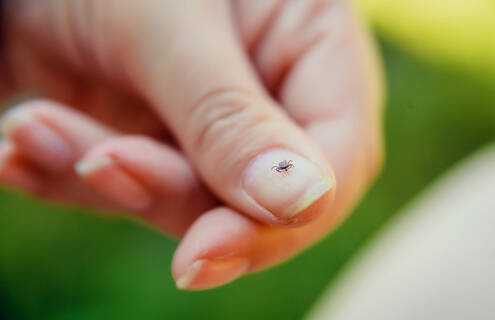
The U.S. Centers for Disease Control and Prevention (CDC) is concerned about an early rise in tick bites. What should you be watching for?
At the end of April, the CDC reported that tick bites were sending Americans to the emergency room (ER) at the highest rate in nearly 10 years, with the Northeast region showing the largest spike, according to their Tick Bite Data Tracker.
Once more, the reported continued rise in tick-borne illnesses is not limited to Lyme disease. Tick bites are resulting in a greater incidence of several tick-borne illnesses.
But there are clear steps you can take to prevent getting infected. That includes knowing how to spot the most common cause of tick-borne illness, the blacklegged tick.
Here’s the latest from Dartmouth Health experts and others about what you need to know this tick season in Vermont and New Hampshire, and how to prevent getting a tick-borne illness.
The blacklegged tick is your biggest risk.
In New Hampshire and Vermont, the blacklegged tick, also known as the deer tick, carries most tick-borne illnesses.
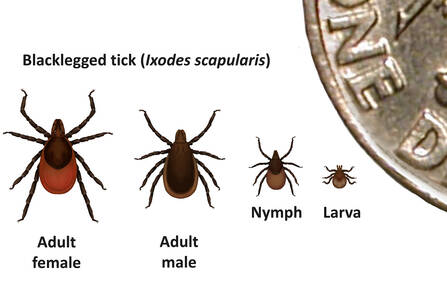
These ticks are most active in the late spring and summer months, but they can be found any time of year when temperatures are above freezing.
“With the warming environment, one can contract a tick-borne disease throughout the year," says Infectious Disease Expert Jeffrey Parsonnet, MD, of Dartmouth Health's Dartmouth-Hitchcock Medical Center (DHMC).
While there are other types of ticks in the region (including dog ticks, woodchuck ticks, and even a growing number of lone star ticks), blacklegged ticks present the greatest risk in the area, particularly for Lyme disease.
In fact, some 50% of adult blacklegged ticks and 25% of nymphs in the Northeast carry the pathogen that causes Lyme disease, says this Dartmouth College study.
“Deer ticks are very small,” explains Parsonnet. “Oftentimes, people don't notice an attached tick because it is on their back or their legs.”
Nymphs are only about the size of a poppy seed. Adults are the size of a sesame seed.
Blacklegged ticks can carry many pathogens.
Lyme is not the only infectious disease that can result from the blacklegged tick’s bite.
In New Hampshire and Vermont, a blacklegged tick can give you anaplasmosis, babesiosis, hard tick relapsing fever (also known as HTRF or Borrelia miyamotoi), and Powassan virus.
Though less common than Lyme, cases of anaplasmosis and babesiosis have been increasing of late.
Powasson virus remains very rare. Last year, Vermont, which provides this helpful information on the virus, had no cases, while New Hampshire had two cases.
Alpha-gal syndrome currently has a limited impact in the region.
Nationally, there is growing concern about the lone star tick. A bite by this tick can cause Alpha-gal syndrome (AGS), which can potentially result in a life-threatening allergic reaction to red meat and dairy.
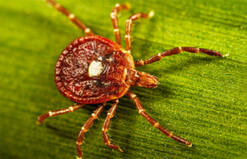
These are reports of concern about the presence of the lone star tick in New England, including in New Hampshire.
But while reports like this one by CBS News say that AGS is an emerging public health concern in Massachusetts, the Vermont Department of Health says the tick is not yet considered established or able to complete its entire life cycle in the Green Mountain State.
New Hampshire officials acknowledge the presence of the tick, but they have only just started a system for taking case reports of AGS.
The best way to avoid tick-borne illness? Keep ticks off you.
As noted in this article about staying safe during tick season, you can take preventative measures, including:
- When you go outside, try to avoid grassy, brushy, or wooded areas, and walk in the center of trails when hiking.
- Treat clothing and gear with products containing 0.5% permethrin, a type of insecticide.
- Wear light-colored clothing that makes it easier to see ticks, and that covers your arms and legs.
- Tuck your pants into your socks.
- Make a practice of using an insect repellent that contains DEET, picaridin, oil of lemon eucalyptus or another EPA-registered repellent. The EPA has a search tool that can help you find the best product for you.
After spending time outdoors, do a thorough tick check.
Check your clothing, shower, and do a full body check after being outside. Putting your clothes in the dryer on high heat for 10 minutes will kill ticks. And don’t forget to protect your pets using a monthly tick preventative medicine and to examine them for ticks.
The blacklegged tick needs to be attached for 24 hours or more to give you Lyme. “If the tick is not attached, or has not been attached for 24 hours or more, you have nothing to worry about,” says Marika Henegan, MD, medical director of Urgent Visits at Cheshire Medical Center, a member of Dartmouth Health.
If the tick is attached, be sure to remove the tick immediately, using tweezers or a tick-remover tool, and clean the area with alcohol or disinfecting soap and water.
How do you safely remove an attached tick?Once a tick bites you, it will likely attach itself to you and won’t let go until it is full. Depending on the type of tick, this may take three to 10 days. The CDC recommendations are:
|
What symptoms should you watch for?
Try to stay aware of general symptoms for tick-borne diseases. While each has different symptoms, many present with nonspecific symptoms.
New Hampshire Health and Human Services reports that common symptoms for tick-borne illnesses can include:
- Fever
- Chills
- Malaise (not feeling well)
- Headache
- Muscle and joint pain
- Lymphadenopathy (enlarged lymph nodes)
Some people may also present with other systemic (body systems) symptoms that are:
- Neurological
- Cardiovascular
- Gastrointestinal
Remember, though, that each disease is different. The primary symptom of Lyme disease is a flat, expanding red rash, but it is not always evident.
If you get symptoms that could indicate a tick-borne illness, call your healthcare provider.
Let your healthcare provider do the testing.
Generally, the CDC does not recommend that you send your tick to a lab for testing.
Let a healthcare provider make the diagnosis.
But detecting tick-borne illnesses can sometimes be tricky and require different methods depending on the type of illness, how much time has elapsed since you were bitten, and your symptoms.
In addition, research continues on developing new diagnostic tools. A team lead by Guohong (Grace) Huang, PhD, of the Laboratory for Clinical Genomics and Advanced Technology at DHMC, is right now leading a team investigating the potential of using skin biopsies of lesions to test for Lyme disease in patients who do not present the typical "bull's-eye" rash and have not yet developed detectable antibodies.
The goal of their work is to improve early detection and diagnostic accuracy, especially in cases where current standard testing is less sensitive.
There is also emerging research around vaccines. The Washington Post recently reported that Pfizer is awaiting approval of a Lyme disease vaccine with 70% effectiveness.
Learn about recommended treatment.
Lyme disease can be effectively treated with appropriate antibiotics after the onset of infection, according to this Dartmouth Health article.
“There’s a misperception that Lyme disease is difficult to treat,” says Parsonnet. “Another misunderstanding is that once you have Lyme disease, it stays with you forever.”
But the duration and type of antibiotic may vary depending on how far the disease has progressed.
For anaplasmosis, doxycycline is usually the recommended treatment for adults and children, according to the CDC.
Babesiosis is typically treated by a combination of antimicrobial drugs.
Symptoms for HTRF typically resolve within 24 to 72 hours after administration of antibiotics, says the CDC.
Powasson is a virus, not a bacterial infection, and has no cure. AGS is an allergic reaction.