

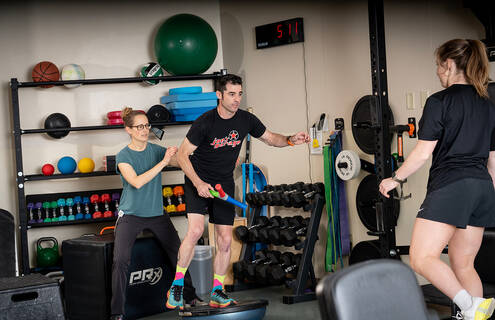
There’s something to be said about keeping our independence, staying active, and maintaining where you’re at for the long-term.
Jordan L. Mousley, PT, Mt. Ascutney Hospital and Health CenterWe need to move our bodies to stay healthy. But reaching, pulling, lifting, and stepping can feel harder as we age or recover from an injury.
That’s where functional fitness can help. By training your body to be strong, stable, and coordinated, functional fitness can support everyday tasks and activities like carrying groceries, getting up from a chair, hiking, and playing sports.
“Nearly everyone can benefit from functional fitness, whether your goal is to be able to lift your grandchild, work in your garden, or return to a sport,” says Michael S. Kerner, DPT, OCS, of the Sports Conditioning Program at Dartmouth Hitchcock Medical Center (DHMC).
How does functional fitness work?
The science behind functional fitness shows that multi-joint, multi-muscle movements not only build strength and endurance more efficiently, but also improve how your brain and muscles work together during real-life activities.
So instead of isolating a single muscle like a bicep curl, functional fitness exercises focus on movements like squats, lunges, and step-ups. Those exercises can boost your balance, coordination, strength, and mobility.
“You’re engaging these muscle groups to mimic a task of real life. And I think you can really get more bang for your buck that way and also burn more calories,” says Neal Goldenberg, MD, director of Sports Medicine at Cheshire Medical Center, a member of Dartmouth Health.
Functional fitness also primes the nervous system, helping your muscles and nerves communicate more efficiently. That enhances your body’s ability to respond quickly and smoothly to changes in position or direction, which you need for agility, Goldenberg explains.
A 2021 study in the British Journal of Sports Medicine found that 54% of people in their early to mid-70s were unable to balance themselves on one leg for 10 seconds without holding on to something.
When your stability decreases, activities like walking down the stairs, avoiding obstacles, going for a hike, and walking on uneven ground can become more challenging. That can increase your chances of falling and make everyday activities more difficult.
Starting functional fitness as a young or middle-aged adult can benefit you now and in the future.
“There’s something to be said about keeping our independence, staying active, and maintaining where you’re at for the long-term,” says Jordan L. Mousley, an outpatient physical therapist at Mt. Ascutney Hospital and Health Center, a member of Dartmouth Health. “Functional fitness is a flexible philosophy where you can tailor it to meet you where you are at and where you want to be.”
What about using it with other exercise programs?
Functional fitness can be incorporated alongside other forms of exercise, such as CrossFit, High-Intensity Interval Training (HIIT), or traditional strength training, Goldenberg says.
He explains that exercise programs like CrossFit often include functional movements.
The core movements in CrossFit, like squats, lunges, and deadlifts, are staples of functional fitness. The difference is that CrossFit may emphasize high-intensity, timed workouts, while functional fitness might prioritize perfecting movement patterns, proper form, and injury prevention.
Goldenberg, an orthopedist, uses functional fitness in his own training and for his athlete patients as it builds strength, balance, and agility.
Can functional fitness reduce pain?
If you have chronic pain, certain movements like bending forward can trigger a heightened pain response, says Olivia J. Franceschelli, an occupational therapist in the Functional Restoration Program at DHMC.
“The nervous system becomes more sensitive to that movement because, over time, you’ve learned to avoid it, anticipating that it will cause pain,” she says.
That can lead to a cycle where fear of pain causes you to move less, which can exacerbate pain and disability.
“By practicing movement patterns, we guide our brains to adapt and reorganize, learning that movement doesn’t have to be painful,” Franceschelli explains. “Functional fitness creates a positive feedback loop. Moving more boosts confidence, which encourages even more movement and improves overall function.”
More than a fad
Newer fitness trends and workouts like CrossFit and HYROX have made the concept of functional fitness more popular, but the movements themselves are fundamental and widely applicable, Goldenberg says.
“Functional fitness doesn’t necessarily require equipment, a lot of space, or a lot of time,” he adds. “It’s never too early to start. And the best part? Anybody can do it.”
Subscribe to the Living Better newsletter
Your trusted resource for reliable and up-to-date health and wellness information in the Northeast. Get it delivered to your inbox every other week.
Functional fitness exercises to try at home
Squats
- Stand with feet shoulder-width apart.
- Push your hips back and bend your knees as if sitting in a chair, keeping your chest upright.
- Go as low as comfortable, then return to standing.
- Modification: Only go as deep as comfortable; use a chair for support if needed.
Deadlifts (Single-leg and Two-leg)
- For two-leg: Stand with feet hip-width apart, hold weights (optional).
- Hinge at the hips with a slight bend in knees, lowering weights toward the floor while keeping your back flat.
- Return to standing by driving hips forward.
- For single-leg: Stand on one leg, hinge at the hip, let the non-standing leg extend behind for balance, return to start.
Lunges
- Step one foot forward and lower your body until both knees are bent at about 90 degrees.
- Push back to start and repeat on the other side.
- Modification: Do shallow lunges or hold onto a support.
Push-ups
- Start in a plank position, hands under shoulders.
- Lower your body toward the floor, keeping your elbows at 45 degrees.
- Push back up to plank.
- Modification: Do on the knees or perform incline push-ups against a wall or bench.
Planks
- Forearms on the floor, elbows under shoulders, legs extended behind.
- Keep your body straight from head to heels, hold for time.
Glute Bridges
- Lie on your back, knees bent, feet flat on the floor.
- Press through the heels to lift the hips toward the ceiling, squeezing the glutes at the top.
- Lower with control.
Bent-over Rows (with dumbbells or bands)
- Stand with knees slightly bent, hinge at the hips, and keep the back flat.
- Hold weights or resistance bands, pull them to your hips, squeezing shoulder blades together, then lower.
Bear Crawls
- Start on all fours, lift knees an inch off the ground.
- Move the opposite hand and foot forward in a crawling motion, keeping the hips low and the core tight.
- Press through the heels to lift the hips toward the ceiling, squeezing the glutes at the top.
Check with your health provider about starting a new exercise program.
Resources + Related Stories
Functional Restoration Program
9 Common Running Injuries and Prevention Tips to Keep You on Track