

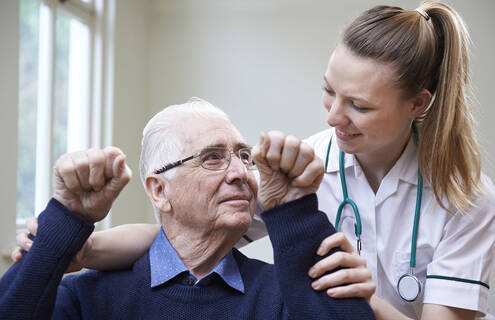
May marks National Stroke Awareness Month, a time to raise awareness about the risk factors for stroke and reduce the occurrence of stroke in the United States. Stroke is the fifth leading cause of death in the U.S. and a leading cause of adult disability. On average, someone in the U.S. suffers a stroke every 40 seconds, and nearly 795,000 people suffer a new or recurrent stroke each year.
For those who have survived a stroke and their loved ones, a return to "normal" life can be challenging. Occupational therapy offers many tools for survivors and their families to reclaim some normalcy, achieve fuller function and autonomy, and find new ways of doing things.
"When you have a stroke, your life, and the lives of those around you, are suddenly turned upside down. It is a very stressful, scary time for families," said Cindi Zipoli, OT/L, an occupational therapist with the Inpatient Physical Rehabilitation Unit at Dartmouth Health's Cheshire Medical Center. "It takes a complete recalibration of your expectations, role, function, and pieces of your identity. You have to find ways to still participate meaningfully in what is most important to you."
For those navigating life after a stroke, Zipoli offers the following tips for living well post-stroke.
- Practice patience and encourage autonomy: Caregivers can overestimate how much care and assistance a stroke survivor needs. Allow your loved one to function to the best of their ability without your help, even if it takes much longer than doing it for them. The feeling of success from small wins supplies the motivation to keep practicing and improving while recovering.
- Set your environment up for success: Home modifications and assistive tools are often necessary. Write down your struggles between appointments with your occupational therapist. They will problem-solve with you to ensure safety while enabling autonomy. Granite State Independent Living, a nonprofit organization, offers support for ramps and modifications, and online stores carry many tools designed to assist people with arthritis or mobility issues.
- Find a new routine that works for you: Both caregiving and living with new symptoms require everyone involved to adjust their expectations of roles, routines, and needs. Plan your day according to your new reality and capabilities. Perhaps showering and dressing takes significant effort each morning, so showers are easier to undertake before bed. Make sure you plan to rest into your routine to help you heal.
- Find appropriate support (more than you think you need): Stroke survivors and caregivers require support. Personality changes and depression or anxiety are common and may improve with counseling or medication. You can speak openly in online support groups and forums to others who understand your situation, while benefitting from their experience and problem-solving. Finding support also means delegating and asking for help with as many tasks as possible, so a network of caregivers can balance their own needs and step in for one another.
- Cultivate a positive attitude: Attitude is the most essential factor in every patient's recovery. Those who keep trying and celebrating every win see the best outcomes. There are always setbacks, and recovery is never linear, but keep trying to do everything you can. It will be worth it.
About Dartmouth Health
Dartmouth Health, New Hampshire’s only academic health system and largest private employer, serves patients across New England. Dartmouth Health provides access to more than 2,300 providers in nearly every area of medicine, delivering care at its flagship hospital, Dartmouth Hitchcock Medical Center (DHMC) in Lebanon, NH. Its network of hospitals, outpatient centers, clinics and home care facilities, spans a broad geographical area. Year after year, DHMC is named the #1 hospital in New Hampshire by U.S. News & World Report, and is consistently recognized for high performance in numerous clinical specialties and procedures. Dartmouth Health includes Dartmouth Cancer Center, northern New England’s only National Cancer Institute-designated Comprehensive Cancer Centers and one of less than than 60 total nationally; Dartmouth Health Children’s, which includes the state’s only children’s hospital, the Golisano Children's Hospital at Dartmouth Health, and more than 20 locations around the region; eight member hospitals in Lebanon, Keene, Claremont, Hampstead, and New London, NH, and Windsor and Bennington, VT; Dartmouth Health Home Care; Dartmouth Health Connected Care Center for Telehealth, serving patients as far away as Texas; and more than 30 primary and multi-specialty clinics across New Hampshire and Vermont. Through its partnership with Dartmouth College, Dartmouth’s Geisel School of Medicine and the White River Junction VA Medical Center, Dartmouth Health trains nearly 400 medical residents and fellows annually and performs cutting-edge research and clinical trials with international impact. Dartmouth Health and its more than 16,000 employees are committed to serving the healthcare needs of everyone in the communities it serves and to providing every patient with exceptional, state-of-the-art, personalized care. Learn more at dartmouth-health.org.