

It is incredibly easy to fall into the trap of presuming that the model ‘sees’ the same way we do. In the end, it doesn’t. It is almost like dealing with an alien intelligence.
Brandon G. Hill, study co-authorMedicine, like most fields, is transforming as the capabilities of artificial intelligence expand at lightning speed. AI integration can be a useful tool to healthcare professionals and researchers, including in interpretation of diagnostic imaging. Where a radiologist can identify fractures and other abnormalities from an X-ray, AI models can see patterns humans cannot, offering the opportunity to expand the effectiveness of medical imaging.
A study led by Dartmouth Health researchers, in collaboration with the Veterans Affairs Medical Center in White River Junction, VT, and published in Nature’s Scientific Reports, highlights the hidden challenges of using AI in medical imaging research. The study examined highly accurate yet potentially misleading results—a phenomenon known as “shortcut learning.”
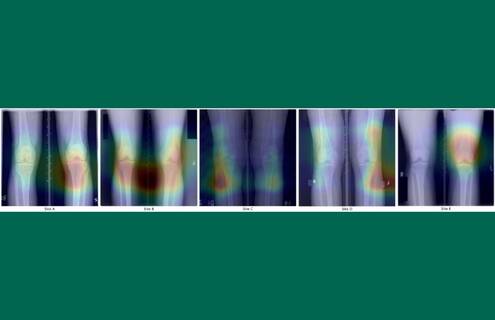
Using knee X-rays from the National Institutes of Health-funded Osteoarthritis Initiative, researchers demonstrated that AI models could “predict” unrelated and implausible traits, such as whether patients abstained from eating refried beans or drinking beer. While these predictions have no medical basis, the models achieved surprising levels of accuracy, revealing their ability to exploit subtle and unintended patterns in the data.
“While AI has the potential to transform medical imaging, we must be cautious,” said Peter L. Schilling, MD, MS, an orthopaedic surgeon at Dartmouth Health’s Dartmouth Hitchcock Medical Center (DHMC) and an assistant professor of orthopaedics in Dartmouth's Geisel School of Medicine, who served as senior author on the study. “These models can see patterns humans cannot, but not all patterns they identify are meaningful or reliable. It’s crucial to recognize these risks to prevent misleading conclusions and ensure scientific integrity.”
Schilling and his colleagues examined how AI algorithms often rely on confounding variables—such as differences in X-ray equipment or clinical site markers—to make predictions rather than medically meaningful features. Attempts to eliminate these biases were only marginally successful—the AI models would just “learn” other hidden data patterns.
The research team’s findings underscore the need for rigorous evaluation standards in AI-based medical research. Over-reliance on standard algorithms without deeper scrutiny could lead to erroneous clinical insights and treatment pathways.
“This goes beyond bias from clues of race or gender,” said Brandon G. Hill, a machine learning scientist at DHMC and one of Schilling’s co-authors. “We found the algorithm could even learn to predict the year an X-ray was taken. It’s pernicious; when you prevent it from learning one of these elements, it will instead learn another it previously ignored. This danger can lead to some really dodgy claims, and researchers need to be aware of how readily this happens when using this technique.”
“The burden of proof just goes way up when it comes to using models for the discovery of new patterns in medicine,” Hill continued. “Part of the problem is our own bias. It is incredibly easy to fall into the trap of presuming that the model ‘sees’ the same way we do. In the end, it doesn’t. It is almost like dealing with an alien intelligence. You want to say the model is ‘cheating,’ but that anthropomorphizes the technology. It learned a way to solve the task given to it, but not necessarily how a person would. It doesn’t have logic or reasoning as we typically understand it.”
To read Schilling and Hill’s study—which was also authored by Frances L. Koback, a third-year student at the Geisel School of Medicine at Dartmouth—visit bit.ly/4gox9jq.
About Dartmouth Health
Dartmouth Health, New Hampshire’s only academic health system and largest private employer, serves patients across New England. Dartmouth Health provides access to more than 2,300 providers in nearly every area of medicine, delivering care at its flagship hospital, Dartmouth Hitchcock Medical Center (DHMC) in Lebanon, NH. Its network of hospitals, outpatient centers, clinics and home care facilities, spans a broad geographical area. Year after year, DHMC is named the #1 hospital in New Hampshire by U.S. News & World Report, and is consistently recognized for high performance in numerous clinical specialties and procedures. Dartmouth Health includes Dartmouth Cancer Center, northern New England’s only National Cancer Institute-designated Comprehensive Cancer Centers and one of less than than 60 total nationally; Dartmouth Health Children’s, which includes the state’s only children’s hospital, the Golisano Children's Hospital at Dartmouth Health, and more than 20 locations around the region; eight member hospitals in Lebanon, Keene, Claremont, Hampstead, and New London, NH, and Windsor and Bennington, VT; Dartmouth Health Home Care; Dartmouth Health Connected Care Center for Telehealth, serving patients as far away as Texas; and more than 30 primary and multi-specialty clinics across New Hampshire and Vermont. Through its partnership with Dartmouth College, Dartmouth’s Geisel School of Medicine and the White River Junction VA Medical Center, Dartmouth Health trains nearly 400 medical residents and fellows annually and performs cutting-edge research and clinical trials with international impact. Dartmouth Health and its more than 16,000 employees are committed to serving the healthcare needs of everyone in the communities it serves and to providing every patient with exceptional, state-of-the-art, personalized care. Learn more at dartmouth-health.org.