

The age of the internet has made connection easier and information more readily available than ever before, but it comes with drawbacks. Social media and the 24-hour news cycle have heightened anxiety and stress in a huge portion of the population. Paired with a seemingly unending stream of historical events in recent years—from the COVID-19 pandemic, to escalating and frequent climate disasters, and even the near-assassination of a major party’s nominee for president on live television less than three weeks ago—have many feeling anxious who didn’t before, and worsened the condition for those who already live with anxiety.
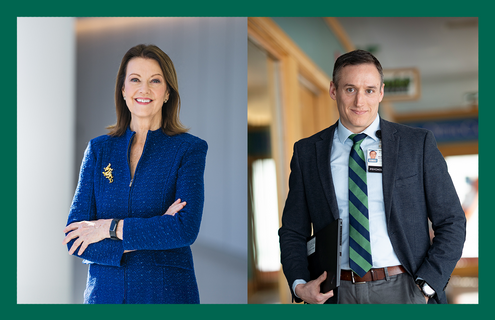
As part of her role as board chair of the American Hospital Association, Dartmouth Health CEO and president Joanne M. Conroy, MD, hosts a monthly Leadership Dialogue video series with leaders across various sectors of healthcare. Conroy was joined this week by Robert E. Brady, PhD, director of Dartmouth Health’s Anxiety Disorders Service. Brady and Conroy discuss the increasing prevalence of anxiety disorders, and why things within our control—as simple as turning off the TV or spending less time on social media—can make a positive difference.
“It’s so constant that you think, ‘It has to be important if they’re putting it on a website this many times,’” Brady said. “But we sometimes fail to remember that the normal stuff of life doesn’t make social media or the news—just the scary stuff. The more you see it, the more you think, ‘This is something I have to be worried about.’”
“This discussion is especially important given our current environment, when events from national news to personal challenges can ratchet up our individual anxiety,” Conroy said. “Dr. Brady shares that more than 30% of Americans have diagnosed anxiety disorders, and almost all of us will suffer from anxiety at some point in our lives. That makes it critically important for our communities, patients, families and workforce to have tools they need to reduce stress and anxiety—to improve both their psychological and physical health.”
About Dartmouth Health
Dartmouth Health, New Hampshire’s only academic health system and largest private employer, serves patients across New England. Dartmouth Health provides access to more than 2,300 providers in nearly every area of medicine, delivering care at its flagship hospital, Dartmouth Hitchcock Medical Center (DHMC) in Lebanon, NH. Its network of hospitals, outpatient centers, clinics and home care facilities, spans a broad geographical area. Year after year, DHMC is named the #1 hospital in New Hampshire by U.S. News & World Report, and is consistently recognized for high performance in numerous clinical specialties and procedures. Dartmouth Health includes Dartmouth Cancer Center, northern New England’s only National Cancer Institute-designated Comprehensive Cancer Centers and one of less than than 60 total nationally; Dartmouth Health Children’s, which includes the state’s only children’s hospital, the Golisano Children's Hospital at Dartmouth Health, and more than 20 locations around the region; eight member hospitals in Lebanon, Keene, Claremont, Hampstead, and New London, NH, and Windsor and Bennington, VT; Dartmouth Health Home Care; Dartmouth Health Connected Care Center for Telehealth, serving patients as far away as Texas; and more than 30 primary and multi-specialty clinics across New Hampshire and Vermont. Through its partnership with Dartmouth College, Dartmouth’s Geisel School of Medicine and the White River Junction VA Medical Center, Dartmouth Health trains nearly 400 medical residents and fellows annually and performs cutting-edge research and clinical trials with international impact. Dartmouth Health and its more than 16,000 employees are committed to serving the healthcare needs of everyone in the communities it serves and to providing every patient with exceptional, state-of-the-art, personalized care. Learn more at dartmouth-health.org.