

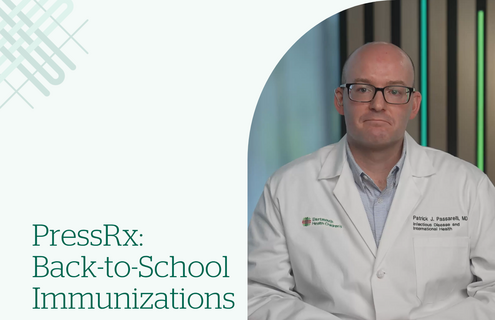
As children across New Hampshire and Vermont prepare to return to class, Dartmouth Health Children’s is encouraging families to make sure children are up to date on vaccines, and to seek information from trusted medical sources when questions arise.
“Vaccines are on the front of a lot of people’s minds lately, and they’re always on the front of my mind, especially as young people are heading back to classrooms and trying to make sure they’re as protected as possible,” said, Patrick Passarelli, MD, a pediatric infectious disease physician at Dartmouth Health Children’s.
Editor’s note: Broadcast-quality video and audio can be found here. This video content is cleared for use by media outlets on all digital and broadcast platforms, with credit to Dartmouth Health. Transcripts are at the bottom of this release.
Routine school-required vaccinations in New Hampshire and Vermont include protection against diphtheria, tetanus, pertussis, measles, mumps, rubella, varicella, polio, and hepatitis B. Passarelli said families should talk with their child’s doctor if that child has missed recommended vaccinations or if they are unsure which vaccines their child has previously received.
“It’s really important to talk to your doctor or your medical provider to find out which vaccines are missing and which need to be given and at what time periods,” Passarelli said. “But it’s a great reason to get into the office to discuss that.”
Recommended vs. required vaccines
Passarelli encouraged families to consider vaccines and other immunizations that are recommended, but may not be part of routine school requirements, including RSV, influenza, COVID-19, and HPV vaccinations.
RSV is particularly concerning for young infants, he said. The virus results in hospitalization for 2% of infants in the United States each year and can cause severe respiratory illness.
Passarelli also emphasized the importance of annual influenza vaccination, noting that several hundred children die from the flu in the United States each year and that about 90% of those children were not vaccinated.
“The flu vaccine doesn’t prevent actual infection very well, but what it does do is prevent the life-threatening complications of infection,” he said.
For preteens, Passarelli highlighted the vaccine for the human papilloma virus, or HPV, which helps prevent several types of cancer. Cervical cancer kills about 4,000 people in the United States each year, he said.
Vaccine timing
Some parents with concerns about giving multiple vaccines at the same time may consider spacing vaccinations further apart. Passarelli said there’s no need, explaining that the routine childhood vaccine schedule has been extensively studied and demonstrated to be safe and effective.
“When people start to space out their vaccinations, it risks getting infected with the exact things we’re trying to prevent before you can get in for the next vaccine,” he said.
Turning to trusted sources
Whether parents encounter vaccine information on television, social media, or other platforms, Passarelli said families should consult medical and public health organizations with expertise in childhood immunization.
He recommends resources including:
American Academy of Pediatrics
New Hampshire Department of Health and Human Services
Vaccine Education Center at Children’s Hospital of Philadelphia
Immunize.org
“We all want the best for ourselves and our children,” said Passarelli. “It’s a normal response to have questions about a vaccine.”
Passarelli said parents should feel empowered to bring questions to their child’s healthcare provider and discuss concerns before making decisions about vaccinations.
What new federal guidelines mean for families
A new executive order, signed on Aug. 10, calls for changes to the federal childhood vaccine recommendations, including spacing out vaccinations across separate medical visits. The order itself does not change school vaccination requirements in New Hampshire or Vermont, which are established by state law.
“The executive order is not actually a legally binding document,” said Passarelli. “At most, it is a suggestion to the states to think about revising the vaccine schedule.”
Passarelli said there is no scientific evidence that spacing childhood vaccinations further apart is safer or provides protection against autism, encouraging families to continue following the established vaccination schedule and to consult their healthcare providers with questions.
Transcripts
"I always defend the flu vaccine because I think it gets a little bit of a bad rap even from medical providers. It was never designed to prevent infection, and that's a principle in vaccinology. In a lot of cases, we don't really focus on the prevention of infection itself, but on the disease that it causes. And so the flu vaccine doesn't prevent actual infection very well, but what it does do is prevent the life-threatening complications of infection." (0:25)
"There's a really important distinction between getting sick or getting an illness and the occasional reactions that you can have after a vaccine. And I always use myself as an example. The day after I get my yearly flu vaccine, I always have a little bit of a tough day. I'm a little tired, a little achy, but I know that's my body's immune system ramping up and learning how to fight off flu in case I encounter it, which I almost inevitably do taking care of patients in the flu season." (0:26)
"When people start to space out their vaccinations, it risks getting infected with the exact things we're trying to prevent before you can get in for the next vaccine. So I always encourage people to kind of stick to the regular schedule as much as they can." (0:14)
"Getting your child vaccinated is ensuring that they're protected as much as you can that's within your control. And it's really scary because there is a lot that's not in our control. And so that's one thing that really is. So that's why I always encourage it as kind of number one is protecting the health of your child." (0:19)
About Dartmouth Health Children's
Dartmouth Health Children’s is the most comprehensive pediatric healthcare system in the region and the first integrative medicine children’s health system in the country. Dartmouth Health Children’s is fully integrated in Dartmouth Health and anchored in Lebanon, NH, by Dartmouth Health’s Golisano Children’s Hospital (also a member of the nationwide Golisano Children’s Alliance): home of the highest acuity neonatal intensive care unit and only pediatric intensive care unit in New Hampshire, along with the only adolescent medical-psychiatry unit in northern New England. Through a unique partnership with the state of New Hampshire at Hampstead Hospital, Dartmouth Health Children’s also provides the state’s only inpatient psychiatric care for children and adolescents. Dartmouth Health Children’s advances knowledge through groundbreaking research and education as the primary pediatric partner of the Geisel School of Medicine at Dartmouth and delivers the best patient- and family-centered care for infants, children, and adolescents in a range of settings across New Hampshire and Vermont. Outpatient specialty visits and same-day surgery services are available at Dartmouth Hitchcock Clinics in Manchester, NH, with pediatric primary care at nearly every Dartmouth Health member location.