

This program promises to save lives and improve patient outcomes like never before.
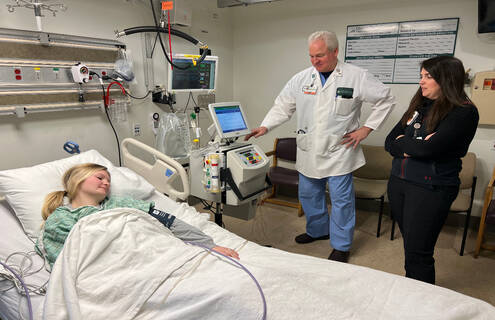
Robert Westlake, MDCheshire Medical Center, a member of Dartmouth Health, now offers continuous renal replacement therapy (CRRT) in its intensive care unit (ICU), a form of 24-hour dialysis. The new treatment empowers Cheshire clinicians to care for a higher volume of seriously ill patients, improves outcomes and enables patients with kidney injuries to remain close to their home community while they receive treatment. The hospital purchased two CRRT machines, trained the ICU staff on how to use them and with support from the section of Nephrology at Dartmouth Hitchcock Medical Center (DHMC) in Lebanon, began using them earlier this summer.
“All of us at Cheshire are immensely proud to offer this treatment for patients experiencing renal failure,” said Joseph L. Perras, MD, president and CEO of Cheshire Medical Center. “We understand how important it is for family members of patients recovering from cardiac arrest, or any other serious medical issue that resulted in a sudden loss of kidney function, to have their loved ones nearby. Having this technology here enables them to recover close to home, where previously we would have needed to transport someone to another facility.”
An estimated 60% of ICU patients worldwide develop acute kidney injury, a condition defined by the organ’s sudden failure to work properly, according to a study in critical care medicine, and patients experiencing an acute reduction in kidney function face a mortality rate increase of 25% attributable to the issue. Many kidney failures are caused by an interruption in blood flow to the organ due to cardiac arrest or septic shock from an infection in the bloodstream, for example.
“This program promises to save lives and improve patient outcomes like never before,” said Robert Westlake, MD, medical director of the ICU at Cheshire who first proposed investing in CRRT. “During the COVID pandemic, our ICU was very full, and many patients were experiencing serious kidney trouble. Usually, we would send such patients to facilities like Dartmouth Hitchcock Medical Center in Lebanon or other hospitals to receive CRRT treatment, but when hospitals were at capacity, options for these patients were limited.”
Patients in Cheshire’s intensive care unit also benefit from Dartmouth Health’s Center for Connected Care’s TeleICU service. Dartmouth Health’s TeleICU hub, located within Dartmouth Hitchcock Medical Center, is staffed by board-certified intensivists – physicians who have undergone advanced training in providing care for critically ill patients – and critical care nurses. The TeleICU team collaborates with Cheshire’s bedside clinicians to provide real-time care, support, monitoring and clinical consultations 24/7, allowing even the most critically ill patients to receive care close to home. The clinicians communicate using state-of-the-art, two-way, interactive audiovisual technology. Patients who require CRRT at Cheshire are supported by remote nephrologists at DHMC who are able to use the TeleICU platform to assess patients remotely and guide their treatment in concert with local Cheshire critical care physicians and nurses.
Over the past 20 years, the incidence of acute kidney injury requiring continuous renal replacement has increased by 10% per year. Recognizing the increasing scope of the issue, Cheshire has developed this program to manage it. Since its introduction in early August, this dialysis technology has already been used to save lives. And as a secondary function, the device can also preserve organs and blood for potential donation. In the case of one patient who suffered serious neurological injuries and did not survive, a CRRT device made it possible to provide support so that the patient could donate multiple organs, prolonging the lives of five other individuals.
About Cheshire Medical Center
Cheshire Medical Center (Cheshire) advances the health and wellness of individuals across New Hampshire’s Monadnock Region through outstanding care and exceptional service. Cheshire teams deliver an impressive range of clinical services that support the community's needs. As a member of Dartmouth Health, Cheshire is able to provide services far exceeding those of a typical rural hospital, including extensive programs in primary care, cancer care, cardiology, orthopaedics, and public health. Cheshire patients are also able to access hundreds of highly trained specialists and a depth of clinical and technical resources through its collaboration with Dartmouth Health. Cheshire’s clinical practice is distinguished by an exceptional staff, a strong commitment to safety and quality, and a culture that values the contribution of every staff member and volunteer. Cheshire is the area's largest healthcare provider and leading employer. Along with the services delivered on their Keene campus and satellite locations, the Medical Center partners with local organizations to provide vital services and programs throughout the region. To learn more, call 603-354-5400 or visit cheshiremed.org.
About Dartmouth Health
Dartmouth Health, New Hampshire’s only academic health system and largest private employer, serves patients across New England. Dartmouth Health provides access to more than 2,300 providers in nearly every area of medicine, delivering care at its flagship hospital, Dartmouth Hitchcock Medical Center (DHMC) in Lebanon, NH. Its network of hospitals, outpatient centers, clinics and home care facilities, spans a broad geographical area. Year after year, DHMC is named the #1 hospital in New Hampshire by U.S. News & World Report, and is consistently recognized for high performance in numerous clinical specialties and procedures. Dartmouth Health includes Dartmouth Cancer Center, northern New England’s only National Cancer Institute-designated Comprehensive Cancer Centers and one of less than than 60 total nationally; Dartmouth Health Children’s, which includes the state’s only children’s hospital, the Golisano Children's Hospital at Dartmouth Health, and more than 20 locations around the region; eight member hospitals in Lebanon, Keene, Claremont, Hampstead, and New London, NH, and Windsor and Bennington, VT; Dartmouth Health Home Care; Dartmouth Health Connected Care Center for Telehealth, serving patients as far away as Texas; and more than 30 primary and multi-specialty clinics across New Hampshire and Vermont. Through its partnership with Dartmouth College, Dartmouth’s Geisel School of Medicine and the White River Junction VA Medical Center, Dartmouth Health trains nearly 400 medical residents and fellows annually and performs cutting-edge research and clinical trials with international impact. Dartmouth Health and its more than 16,000 employees are committed to serving the healthcare needs of everyone in the communities it serves and to providing every patient with exceptional, state-of-the-art, personalized care. Learn more at dartmouth-health.org.