

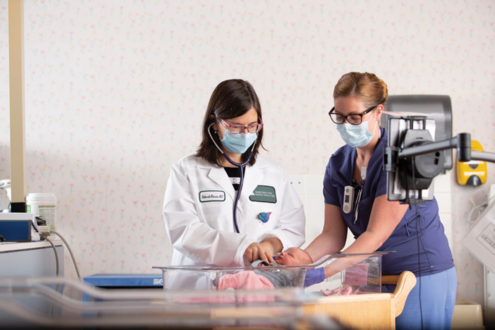
TeleICN gives teams another set of eyes at the bedside. These situations don’t happen every day, and when they do, having another expert perspective helps teams talk through decisions in real time.
Jessica G. Clem, MD, MPHMaternity services in rural America are vanishing.
According to a report from the Center for Healthcare Quality and Payment Reform, fewer than half of rural hospitals (42%) still deliver babies. Since 2020, more than 100 facilities have shut down their labor and delivery units. For many families, the nearest hospital offering maternity care is now more than 30 minutes away, and in some places, nearly an hour or longer. When complications arise, that added distance can make an already stressful situation even more challenging when a newborn needs urgent care.
Against this backdrop of disappearing maternity services, Dartmouth Health’s Connected Care and Center for TeleHealth created TeleICN, a program that ensures expert neonatal support is still within reach for rural hospitals. By connecting local teams with neonatologists in real time, families no longer have to face the crisis of distance alone.
A moment that changed everything
During a quiet overnight shift in a small northern New England hospital, the labor and delivery team received a call that an ambulance was arriving with a patient in preterm labor. Only two nurses were on the unit. The midwife, pediatrician, and obstetrician were on their way.
When mom was wheeled into the room, already pushing, the baby’s head was visible.
For one of the nurses, this would be her first delivery. She assessed the situation and saw the contractions suddenly stop. She had a short window to act.
She opened the TeleICN app.
Within moments, a Dartmouth Health neonatologist joined through secure video and could see the patient and the room. The neonatologist calmly guided the team through the plan.
The operating room was set up for a micro preemie.
A micro preemie is an extremely premature baby, typically born before about 26 weeks of pregnancy and weighing less than about 1½ to 2 pounds—about the size of a small bottle of soda, or small enough to fit in the palm of your hand.
Each person was given a clear role. The nurse later shared that the real-time support changed the tone of the room. Instead of uncertainty, there was direction. Instead of fear, there was confidence.
The newborn was delivered safely, stabilized, and transferred to Dartmouth Hitchcock Medical Center by Dartmouth Health’s neonatal transport team. For that family, expert care was available despite specialists being miles away.
How TeleICN works
TeleICN gives clinicians at rural and community hospitals immediate access to a Dartmouth Health neonatologist 24 hours a day seven days a week. The connection is initiated from the bedside using a secure mobile audio-video device. Within moments, the neonatologist can see the newborn, evaluate the situation, and guide the local team in real time.
At its core, TeleICN is designed to support the skilled clinicians already at the bedside, building on their expertise and strengthening local care rather than replacing it. The goal is collaboration and shared decision-making when situations are rare, complex, or time sensitive.
That collaborative approach is a central part of how TeleICN supports bedside teams, said Jessica G. Clem, MD, MPH, a neonatologist and medical director of TeleICN at Dartmouth Health.
“TeleICN gives teams another set of eyes at the bedside,” Clem said. “These situations don’t happen every day, and when they do, having another expert perspective helps teams talk through decisions in real time.”
While most community hospitals deliver healthy newborns every day, extremely premature or critically ill cases are rare and require a skill set local providers don’t use every day. TeleICN provides an added layer of support in those moments, bringing neonatal expertise directly to the bedside when it matters most.
That expertise makes a critical difference, said Michelle D. Tyler, MD, MPH, a neonatologist with Dartmouth Health’s TeleICN program. “Babies aren’t simply small adults, and they’re different from older children too,” she said. “They can’t speak for themselves, and the situations they face, especially when they’re born very early, are uncommon. Their needs are unique, and they require care tailored specifically to them.”
Depending on the situation, TeleICN support may include:
• Guidance during neonatal resuscitation
• Evaluation and treatment guidance for respiratory distress
• Consultation during high-risk situations or unexpected deliveries
• Support in determining whether transfer to a higher level of care is necessary
TeleICN is designed for speed and simplicity: bedside teams connect with a neonatologist using a secure mobile device, with no telehealth carts or complex equipment required.
Training before launch
Before TeleICN launches at a hospital, the neonatal and telehealth teams arrive on-site to walk clinicians through the workflow, technology, and clinical scenarios they are likely to encounter.
Rural clinicians bring strong clinical skills and deep knowledge of their patients and communities, and TeleICN is designed to support that expertise by providing immediate access to specialized neonatal care when complex situations arise. Training is tailored to what each hospital needs most, and Neonatal Resuscitation Program practice is frequently requested.
As Clem explains, the value of this preparation goes beyond technical readiness.
“The training opens the conversation before there’s ever an emergency,” she said. “When teams meet us in person, it connects a face to a name. That makes it easier to reach out when something unexpected happens, because the relationship is already there.”
Being onsite also allows teams to train in the exact space where care will happen.
“We walk through the unit together, look at where equipment is placed, and talk through how a resuscitation might unfold in that room,” said Tyler, “Some of these situations are rare, and some clinicians may not have encountered them in years. Practicing in their own space helps everyone visualize the moment before they’re in it.”
Clinicians report that the preparation makes a meaningful difference. When an emergency happens, they feel less stress and more confidence because they have already rehearsed the steps. After their first real call, they consistently report feeling more confident navigating similar situations the next time.
Beyond clinical care
The support isn’t limited to clinical care. Neonatologists can speak directly with families by video or phone or guide the local clinician through those conversations, depending on what the situation calls for.
“Sometimes the support isn’t about procedures at all,” said Clem. “It’s about helping teams talk through goals of care and support families in real time, so everyone is focused on what’s best for the baby, at the moment it matters most.”
That shared approach helps ensure families receive clear, compassionate communication while remaining connected to the clinicians they already know and trust.
Expanding support for rural hospitals
When TeleICN first launched, the focus was labor and delivery units. As maternity services began closing throughout the region, emergency departments suddenly found themselves managing an increased number of deliveries and newborn complications. TeleICN adapted in response. The service now supports labor and delivery units, emergency departments, and operating rooms—wherever a rural hospital needs neonatal expertise, around the clock.
“As birthing centers close, more newborns are being cared for in settings that weren’t originally designed for delivery,” said Kevin M. Curtis, MD, MS, medical director of Connected Care and the Center for TeleHealth. “These situations don’t happen often, but when they do, having neonatal expertise immediately available makes a real difference for the baby, the family, and the care team.”
That collaboration at the bedside is what makes the model work.
“TeleICN allows us to anticipate delivery, see the baby together, and support the team through the exam,” said Tyler. “Even when the setting is different, we’re able to work through decisions in real time.”
That same adaptive approach is shaping how Dartmouth Health is thinking about maternal and newborn care more broadly. Building on the success of TeleICN, additional virtual services are extending specialty support earlier in pregnancy and beyond delivery.
Together, these services reflect a coordinated effort to strengthen care across the full continuum—supporting local teams before delivery, during critical moments at birth, and throughout early newborn care—while keeping care close to home whenever possible.
Signs of success
TeleICN is strengthening care delivery for newborns and supporting rural hospitals across the region, and its impact is reflected in how clinicians are using the service.
Clinicians are engaging TeleICN earlier and more often. From 2024 to 2025, usage increased by 48%, reflecting growing confidence and a shift toward engaging neonatal expertise earlier in an emergency.
The earlier engagement is making a difference at the bedside. In more than one-third of TeleICN consultations, newborns were able to stay local at their birth hospital if they are a labor and delivery site. For families, this can mean staying together and avoiding the cost and disruption of hours-long travel during an already stressful time.
For clinicians, the impact is immediate and tangible. As one rural clinician shared in a post-call survey: “The provider was quick to respond and saved this patient many hours of traveling time.”
Post-call survey results confirm the experience:
• 100% agreed that using TeleICN improved the baby’s care
• 100% agreed the technology was easy to use
• 95% agreed they were connected to the neonatologist promptly
As Clem observed, this shift is changing how clinicians approach complex situations:
“What we’re seeing is a shift in how rural clinicians use neonatal expertise,” she said. “They’re reaching out earlier, talking through decisions in real time, and gaining confidence with each case. That kind of support can change how a situation unfolds at the bedside.”
Together, these results show how TeleICN increases clinician confidence, supports timely decision-making, and helps ensure newborns receive specialty-level care when and where it is needed, even when a neonatologist is miles away.
Looking ahead
TeleICN demonstrates that rural hospitals can remain strong anchors for their communities even as maternity services close elsewhere. By delivering immediate specialty support and enabling many newborns to stay safely at their local hospital, the program strengthens teams, preserves continuity of care, and keeps families closer to home.
TeleMFM (maternal-fetal medicine) focusing on high-risk pregnancies is nearing rollout, and TeleOB, aimed at providing additional on-demand obstetric support, is in development. Together, these services build a wraparound model that supports pregnancy, delivery, and newborn care across the region.
Together, these efforts reflect a broader commitment to the future of rural health. The vision of Dartmouth Health Connected Care is to build a fundamentally sustainable health infrastructure that tackles the primary rural health challenges of access, workforce, quality, cost, transportation, and equity, while maintaining local care whenever possible.
Every newborn deserves immediate access to expert care. TeleICN helps make that possible.
About Dartmouth Health
Dartmouth Health, New Hampshire’s only academic health system and largest private employer, serves patients across New England. Dartmouth Health provides access to more than 2,300 providers in nearly every area of medicine, delivering care at its flagship hospital, Dartmouth Hitchcock Medical Center (DHMC) in Lebanon, NH. Its network of hospitals, outpatient centers, clinics and home care facilities, spans a broad geographical area. Year after year, DHMC is named the #1 hospital in New Hampshire by U.S. News & World Report, and is consistently recognized for high performance in numerous clinical specialties and procedures. Dartmouth Health includes Dartmouth Cancer Center, northern New England’s only National Cancer Institute-designated Comprehensive Cancer Centers and one of less than than 60 total nationally; Dartmouth Health Children’s, which includes the state’s only children’s hospital, the Golisano Children's Hospital at Dartmouth Health, and more than 20 locations around the region; eight member hospitals in Lebanon, Keene, Claremont, Hampstead, and New London, NH, and Windsor and Bennington, VT; Dartmouth Health Home Care; Dartmouth Health Connected Care Center for Telehealth, serving patients as far away as Texas; and more than 30 primary and multi-specialty clinics across New Hampshire and Vermont. Through its partnership with Dartmouth College, Dartmouth’s Geisel School of Medicine and the White River Junction VA Medical Center, Dartmouth Health trains nearly 400 medical residents and fellows annually and performs cutting-edge research and clinical trials with international impact. Dartmouth Health and its more than 16,000 employees are committed to serving the healthcare needs of everyone in the communities it serves and to providing every patient with exceptional, state-of-the-art, personalized care. Learn more at dartmouth-health.org.