

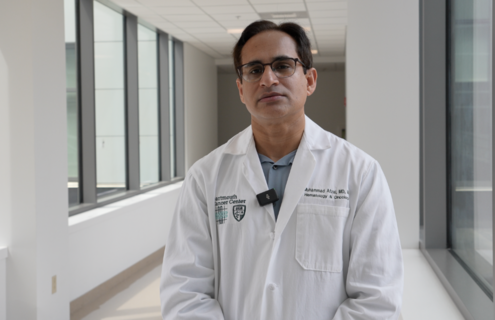
Feeling embarrassed is common, but delaying evaluation can allow the cancer to progress and become more difficult to treat
Muhammad Zubair Afzal, MDRecent public attention surrounding male breast cancer is prompting new conversations about a disease many people do not realize can affect men. While rare, experts say awareness remains low, often leading to delayed diagnosis and treatment.
Male breast cancer accounts for less than 1% of all breast cancer cases. About 2,800 men in the United States are diagnosed with the disease each year, and approximately 530 die from it annually, according to Muhammad Zubair Afzal, MD, board-certified hematologist and medical oncologist at Dartmouth Cancer Center (DCC).
“Because breast cancer is commonly thought of as a ‘women’s disease,’ men often do not recognize early symptoms or delay seeking care,” said Afzal. “Many men wait several months after noticing a lump or change before seeing a doctor. As a result, a higher proportion of men are diagnosed at later stages compared to women, which contributes to worse outcomes.”
The most common symptom of male breast cancer is a painless lump beneath or behind the nipple. Other warning signs include nipple inversion, discharge, or bleeding from the nipple, skin dimpling or redness, thickening of breast tissue, and lumps in the armpit.
“Any new or persistent breast change in a man should be evaluated promptly and not assumed to be benign,” said Afzal.
Several factors can increase a man’s risk of developing breast cancer. The disease is most commonly diagnosed in men between ages 65 and 70. Family history, inherited genetic mutations and certain medical conditions can also increase risk.
“Black men have a slightly higher incidence and mortality compared to other groups,” said Afzal. “Conditions that increase estrogen levels, such as obesity, liver disease, or hormonal disorders, also contribute.”
Unlike women, men are not routinely screened for breast cancer because the disease is uncommon. However, men with inherited genetic mutations or other significant risk factors may benefit from closer monitoring or regular clinical breast exams.
For most men, awareness remains the best tool for early detection.
Treatment for male breast cancer generally follows the same principles used for women and may include surgery, radiation therapy, chemotherapy, hormone therapy and targeted treatments. Most male breast cancers are hormone receptor-positive, making hormone-blocking medications an important part of treatment.
“Feeling embarrassed is common, but delaying evaluation can allow the cancer to progress and become more difficult to treat,” said Afzal. “When found early, male breast cancer can often be treated successfully. Seeking medical care early greatly improves outcomes, and there is nothing unusual about a man developing breast cancer—it is a medical condition that deserves prompt attention like any other cancer.”
For more information about breast cancer care and services available through Dartmouth Cancer Center, visit https://cancer.dartmouth.edu/.
About Dartmouth Cancer Center
Since 1972, Dartmouth Cancer Center (DCC) has combined groundbreaking and advanced cancer research at Dartmouth and the Geisel School of Medicine with award-winning, personalized, compassionate, patient-centered cancer care and clinical trials. At its flagship location at Dartmouth Health’s Dartmouth Hitchcock Medical Center, with 14 locations across New Hampshire and Vermont, DCC is one of fewer than 60 National Cancer Institute-designated Comprehensive Cancer Centers nationally. Each year, DCC manages 74,000 appointments, treats more than 4,500 newly diagnosed patients, and currently offers more than 240 active clinical trials. DCC remains committed to excellence, outreach and education. DCC strives to create new knowledge and impact, accelerate integrated and collaborative research to prevent and cure cancer, enhance survivorship and promote cancer-related health equity. Learn more at cancer.dartmouth.edu.
About Dartmouth Health
Dartmouth Health, New Hampshire’s only academic health system and largest private employer, serves patients across New England. Dartmouth Health provides access to more than 2,300 providers in nearly every area of medicine, delivering care at its flagship hospital, Dartmouth Hitchcock Medical Center (DHMC) in Lebanon, NH. Its network of hospitals, outpatient centers, clinics and home care facilities, spans a broad geographical area. Year after year, DHMC is named the #1 hospital in New Hampshire by U.S. News & World Report, and is consistently recognized for high performance in numerous clinical specialties and procedures. Dartmouth Health includes Dartmouth Cancer Center, northern New England’s only National Cancer Institute-designated Comprehensive Cancer Centers and one of less than than 60 total nationally; Dartmouth Health Children’s, which includes the state’s only children’s hospital, the Golisano Children's Hospital at Dartmouth Health, and more than 20 locations around the region; eight member hospitals in Lebanon, Keene, Claremont, Hampstead, and New London, NH, and Windsor and Bennington, VT; Dartmouth Health Home Care; Dartmouth Health Connected Care Center for Telehealth, serving patients as far away as Texas; and more than 30 primary and multi-specialty clinics across New Hampshire and Vermont. Through its partnership with Dartmouth College, Dartmouth’s Geisel School of Medicine and the White River Junction VA Medical Center, Dartmouth Health trains nearly 400 medical residents and fellows annually and performs cutting-edge research and clinical trials with international impact. Dartmouth Health and its more than 16,000 employees are committed to serving the healthcare needs of everyone in the communities it serves and to providing every patient with exceptional, state-of-the-art, personalized care. Learn more at dartmouth-health.org.