
Dartmouth Health’s Dartmouth Hitchcock Medical Center (DHMC) received a $27.7 million, seven-year grant from the National Institutes of Health (NIH) to fund projects that will speed the implementation of proven medical innovations as part of a national consortium of biomedical research centers.
NIH’s Clinical and Translational Science Award (CTSA) will fund Dartmouth SYNERGY, also known as the Dartmouth Clinical and Translational Science Institute, a joint initiative that includes Dartmouth Health, Dartmouth College’s Geisel School of Medicine and Thayer School of Engineering; the White River Junction VA Medical Center, and collaborating institutions in Vermont and Maine. SYNERGY joins 60 other CTSAs in the United States and is one of eight with a significant focus on rural healthcare delivery.
“This award is an important milestone in the development of the biomedical research enterprise in the Upper Valley,” said Joanne M. Conroy, MD, CEO and president of Dartmouth Health. “The strength of SYNERGY is in its ability to bring together the resources of the health delivery system with the research and teaching assets of our partners at Dartmouth College, and regional collaborators at MaineHealth and the University of Vermont.”
With 50 percent of northern New England’s population living in rural areas, the challenges of rural healthcare delivery are a particular focus of SYNERGY’s work, Conroy said. “Rural Americans are more likely to develop chronic illnesses and die compared to their urban counterparts. However, we are at an exciting time of breakthroughs and improvements in healthcare. This grant fortifies the infrastructure for SYNERGY to drive these innovations from the laboratories to the bedside and beyond.”
Translational science is a growing field that seeks to turn discoveries made in the laboratory, clinics and community settings into interventions that improve the health of individuals and populations. SYNERGY initially received a five-year CTSA grant in 2013. SYNERGY focuses on finding ways to overcome barriers to the adoption of ideas, tools, and treatment approaches that have been proven to work.
Steven L. Bernstein, MD, chief research officer at DHMC, Senior Associate Dean for Clinical and Translational Research and Professor of Emergency Medicine at Geisel, says a major element of SYNERGY’s successful grant proposal was embedding individuals with translational science expertise in operational roles in healthcare systems. Typically, researchers who have developed and proven the success of a treatment method or tool must reach out to administrators and providers and persuade them to consider new approaches. At DHMC, there are already clinicians and others with training in healthcare delivery science, implementation science, quality improvement, and related fields who are best positioned to facilitate the adoption of new evidence-based therapies, diagnostics, and practices.
“It was a strength for us – because we were already doing it,” Bernstein said. “What we are learning, we can generalize for others to learn from and adopt.”
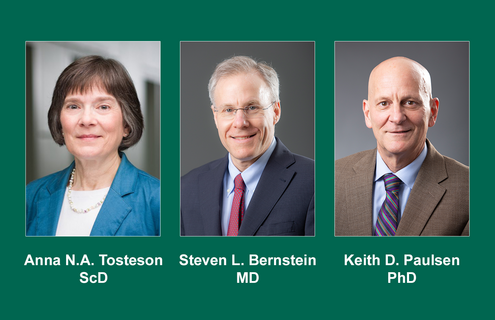
SYNERGY will play a role in training more translational scientists. Part of this work will be led by Anna N.A. Tosteson, ScD, James J. Carroll 1948 Professor of Oncology in the Dartmouth Institute of Health Policy and Practice. Bernstein notes that Tosteson, one of three principal investigators on the CTSA, has already received another federal grant focusing on training in learning health system science that will complement the work of SYNERGY.
The development of technology to improve healthcare is another important element of SYNERGY. The third principal investigator in the CTSA is Keith D. Paulsen, PhD, the MacLean Professor of Engineering at Thayer and director of the Center for Surgical Innovation at DHMC. Paulsen is an expert on medical imaging technologies that have improved the accuracy and safety of complex surgical procedures.
About Dartmouth Health
Dartmouth Health, New Hampshire’s only academic health system and largest private employer, serves patients across New England. Dartmouth Health provides access to more than 2,300 providers in nearly every area of medicine, delivering care at its flagship hospital, Dartmouth Hitchcock Medical Center (DHMC) in Lebanon, NH. Its network of hospitals, outpatient centers, clinics and home care facilities, spans a broad geographical area. Year after year, DHMC is named the #1 hospital in New Hampshire by U.S. News & World Report, and is consistently recognized for high performance in numerous clinical specialties and procedures. Dartmouth Health includes Dartmouth Cancer Center, northern New England’s only National Cancer Institute-designated Comprehensive Cancer Centers and one of less than than 60 total nationally; Dartmouth Health Children’s, which includes the state’s only children’s hospital, the Golisano Children's Hospital at Dartmouth Health, and more than 20 locations around the region; eight member hospitals in Lebanon, Keene, Claremont, Hampstead, and New London, NH, and Windsor and Bennington, VT; Dartmouth Health Home Care; Dartmouth Health Connected Care Center for Telehealth, serving patients as far away as Texas; and more than 30 primary and multi-specialty clinics across New Hampshire and Vermont. Through its partnership with Dartmouth College, Dartmouth’s Geisel School of Medicine and the White River Junction VA Medical Center, Dartmouth Health trains nearly 400 medical residents and fellows annually and performs cutting-edge research and clinical trials with international impact. Dartmouth Health and its more than 16,000 employees are committed to serving the healthcare needs of everyone in the communities it serves and to providing every patient with exceptional, state-of-the-art, personalized care. Learn more at dartmouth-health.org.