

We are excited about the potential of our project to generate meaningful evidence about the best ways to engage patients, care partners, clinicians and the public in research.
Catherine H. Saunders, PhD, MPHA research team led by Dartmouth Health and the Geisel School of Medicine at Dartmouth has been approved for $2,108,902 in funding by the Patient-Centered Outcomes Research Institute (PCORI), to study patient and public involvement (PPI) in research. The study aims to compare two methods of PPI in studies of pediatric mental health, cancer screening, and serious illness and the end-of-life.
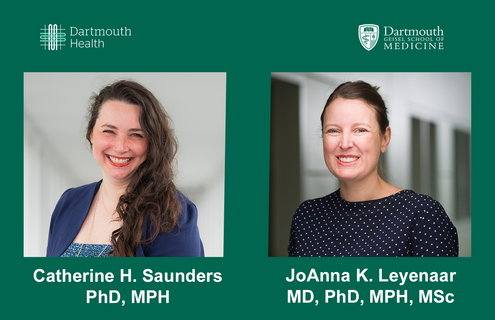
The study is led by Catherine H. Saunders, PhD, MPH, a palliative medicine scientist at Dartmouth Hitchcock Medical Center, and an assistant professor of medicine and of The Dartmouth Institute for Health Policy and Clinical Practice at Geisel; along with JoAnna K. Leyenaar, MD, PhD, MPH, MSc, a pediatric hospital medicine specialist at Dartmouth Health Children’s, and professor of pediatrics and of The Dartmouth Institute at Geisel.
“We are excited about the potential of our project to generate meaningful evidence about the best ways to engage patients, care partners, clinicians and the public in research,” Saunders said. “We believe that PPI is not only the right thing to do, but enhances the validity and rigor of health services research. We look forward to building the evidence base so research teams can confidently select the right PPI approaches for their projects, topics and contexts.”
Leyenaar and Saunders’ team anticipate the study will show the effectiveness of PPI approaches, for the first time in a randomized control trial. Much has been learned in recent years about participatory research with patients, caregivers, clinicians, and others as partners in the research process. However, there has been little systematic study about which methods are most effective.
“I am so honored to be a caregiver partner in this important research to study different approaches to participatory qualitative research,” said Cathy Stevens, care partner co-investigator. “It’s vital to incorporate myriad, diverse partners in research in order to produce the most comprehensive and meaningful data. Through this project we will be learning more about the best ways to engage various partners in order to build engagement and trust. This information will be so valuable for future researchers.”
“This study was selected for PCORI funding for its potential to strengthen patient-centered and stakeholder-driven comparative clinical effectiveness research by providing evidence about specific engagement methods and measures that promote representative engagement of patients and other stakeholders in research,” said PCORI executive director Nakela L. Cook, MD, MPH. “We look forward to following the study’s progress and working with Dartmouth Health to share the results.”
About Dartmouth Health
Dartmouth Health, New Hampshire’s only academic health system and largest private employer, serves patients across New England. Dartmouth Health provides access to more than 2,300 providers in nearly every area of medicine, delivering care at its flagship hospital, Dartmouth Hitchcock Medical Center (DHMC) in Lebanon, NH. Its network of hospitals, outpatient centers, clinics and home care facilities, spans a broad geographical area. Year after year, DHMC is named the #1 hospital in New Hampshire by U.S. News & World Report, and is consistently recognized for high performance in numerous clinical specialties and procedures. Dartmouth Health includes Dartmouth Cancer Center, northern New England’s only National Cancer Institute-designated Comprehensive Cancer Centers and one of less than than 60 total nationally; Dartmouth Health Children’s, which includes the state’s only children’s hospital, the Golisano Children's Hospital at Dartmouth Health, and more than 20 locations around the region; eight member hospitals in Lebanon, Keene, Claremont, Hampstead, and New London, NH, and Windsor and Bennington, VT; Dartmouth Health Home Care; Dartmouth Health Connected Care Center for Telehealth, serving patients as far away as Texas; and more than 30 primary and multi-specialty clinics across New Hampshire and Vermont. Through its partnership with Dartmouth College, Dartmouth’s Geisel School of Medicine and the White River Junction VA Medical Center, Dartmouth Health trains nearly 400 medical residents and fellows annually and performs cutting-edge research and clinical trials with international impact. Dartmouth Health and its more than 16,000 employees are committed to serving the healthcare needs of everyone in the communities it serves and to providing every patient with exceptional, state-of-the-art, personalized care. Learn more at dartmouth-health.org.
About the Geisel School of Medicine at Dartmouth
The Geisel School of Medicine at Dartmouth, founded in 1797, strives to improve the lives of the communities we serve through excellence in learning, discovery, and healing. The nation's fourth-oldest medical school, the Geisel School of Medicine has been home to many firsts in medical education, research and practice, including the discovery of the mechanism for how light resets biological clocks, creating the first multispecialty intensive care unit, the first comprehensive examination of U.S. health care cost variations (The Dartmouth Atlas), and the first Center for Health Care Delivery Science, which launched in 2010. As one of America's top medical schools, Dartmouth's Geisel School of Medicine is committed to training new generations of physician leaders who will help solve our most vexing challenges in health care.