

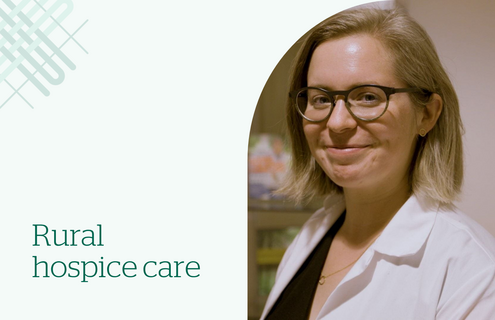
Older adults living in rural communities are less likely to receive hospice care, and when they do, are less likely to receive the most intensive hospice services for severe symptoms, according to a new study led by a Dartmouth Health researcher and published in JAMA.
The study found that 52.4% of older adults who died in urban zip codes received hospice care, compared with 44.8% of those in the most rural zip codes.
Among people who received hospice care, rural and urban patients were similarly likely to receive routine visits from hospice nurses, social works, and aides, despite the longer distances rural hospice teams often travel to reach patients.
“Rural hospice teams are doing a remarkable job of providing routine care to patients despite the challenges of distance and geography,” said Claire Ankuda, MD, MPH, MSc, lead author, palliative medicine physician at Dartmouth Health and Associate Professor of Medicine and of Health Policy and Clinical Practice at Dartmouth’s Geisel School of Medicine. “What we found is that the biggest differences emerge when patients need more intensive, round-the-clock support – and that’s the gap we need to understand better.”
The study found significant differences in access to two types of intensive hospice care. General inpatient hospice care, which provides around-the-clock care for patients with severe symptoms that cannot be managed at home, was provided to 21.7% of hospice patients in urban zip codes compared with 12.7% of patients in the most rural zip codes.
Continuous home care, which provides at least eight hours of nursing care in a patient’s home, was provided to 2.5% of hospice patients in urban zip codes compared with just 0.5% of patients in the most rural zip codes.
The findings highlight challenges facing rural hospice providers, where greater travel distances, workforce shortages, and lower population density can make it more difficult to provide intensive services. The researchers point to one possible fix: a rural payment adjuster that would let Medicare pay rural hospice agencies more for delivering general inpatient and continuous home care, helping offset the added cost of providing intensive services in low-density areas.
“Rural patients should have the same opportunity to receive the level of hospice care they need, regardless of where they live,” said Ankuda. “Understanding what is driving these differences is an important next step so we can identify ways to improve access to high-intensity hospice care in rural communities.”
The study was conducted by researchers from Dartmouth Health/Geisel School of Medicine, the Icahn School of Medicine at Mount Sinai, the University of California, San Francisco, and Dana-Farber Cancer Institute.
The full study, “Rural-Urban Disparities in the Delivery and Intensity of the Medicare Hospice Benefit,” is published in JAMA.
About Dartmouth Health
Dartmouth Health, New Hampshire’s only academic health system and largest private employer, serves patients across New England. Dartmouth Health provides access to more than 2,300 providers in nearly every area of medicine, delivering care at its flagship hospital, Dartmouth Hitchcock Medical Center (DHMC) in Lebanon, NH. Its network of hospitals, outpatient centers, clinics and home care facilities, spans a broad geographical area. Year after year, DHMC is named the #1 hospital in New Hampshire by U.S. News & World Report, and is consistently recognized for high performance in numerous clinical specialties and procedures. Dartmouth Health includes Dartmouth Cancer Center, northern New England’s only National Cancer Institute-designated Comprehensive Cancer Centers and one of less than than 60 total nationally; Dartmouth Health Children’s, which includes the state’s only children’s hospital, the Golisano Children's Hospital at Dartmouth Health, and more than 20 locations around the region; eight member hospitals in Lebanon, Keene, Claremont, Hampstead, and New London, NH, and Windsor and Bennington, VT; Dartmouth Health Home Care; Dartmouth Health Connected Care Center for Telehealth, serving patients as far away as Texas; and more than 30 primary and multi-specialty clinics across New Hampshire and Vermont. Through its partnership with Dartmouth College, Dartmouth’s Geisel School of Medicine and the White River Junction VA Medical Center, Dartmouth Health trains nearly 400 medical residents and fellows annually and performs cutting-edge research and clinical trials with international impact. Dartmouth Health and its more than 16,000 employees are committed to serving the healthcare needs of everyone in the communities it serves and to providing every patient with exceptional, state-of-the-art, personalized care. Learn more at dartmouth-health.org.