

Editor’s note: Broadcast-quality video and audio can be found here. This video content is cleared for use by media outlets on all digital and broadcast platforms, with credit to Dartmouth Health.
Artificial intelligence can be a helpful healthcare tool. But using chatbots to assess symptoms, interpret test results, or decide whether or not to seek medical care can be dangerously misleading.
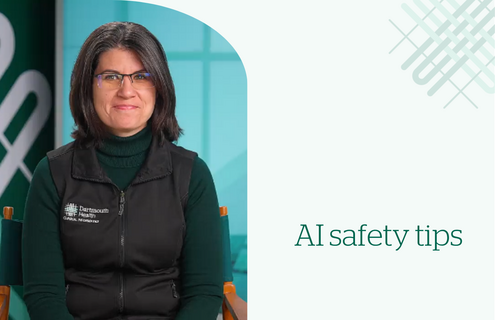
Randa Perkins, MD, MBA, FAMIA, chief health information officer at Dartmouth Health, urges people to approach AI-generated health information with caution, particularly when answers could influence medical decisions.
A Kaiser Family Foundation survey published in 2026 found that one in three adults in the United States had used AI chatbots for health information or advice in the previous year. Patients may turn to AI because they want immediate answers, struggle to access care, or need medical information explained in plain language, according to Perkins. As these tools become part of how people seek answers about their health, Perkins says understanding their limitations is increasingly important.
“Confidence is not the same as accuracy,” said Perkins.
AI tools can explain unfamiliar medical terms, help organize symptoms, and suggest questions to bring to your next appointment. But they cannot examine a patient, may overlook important medical context, and do not necessarily verify every statement against reliable medical evidence.
The consequences of AI misinformation extend further in the healthcare field. A chatbot could cause unnecessary alarm about a relatively common symptom or falsely reassure someone who needs medical attention. People experiencing new chest pressure, severe difficulty breathing, or signs of a stroke should call 911 rather than consulting an AI tool.
Perkins offers several recommendations for people using AI to navigate health questions:
• Use AI to prepare, not diagnose. Ask it to explain a medical term, summarize general information about a condition, or figure out what to ask your healthcare team. Leave decisions about diagnosis, treatment, and the urgency of symptoms to the professionals.
• Be careful with test results. An out-of-range result does not automatically indicate a serious disease, and a result within the reference range does not necessarily rule out a problem. Ask the ordering clinician when to expect their interpretation of the result and reach out to their team if you have questions.
• Protect personal health information. Consumer chatbots do not automatically offer the same privacy protections as healthcare providers. Before sharing information, check the tool’s policies on access, retention, training, and data sharing. Avoid uploading identifiable medical records or screenshots.
• Verify claims and sources. AI-generated answers can sound polished and authoritative, even when they are wrong. Check whether cited sources exist and if they support the claims being made.
• Talk with your healthcare team. If an AI tool contradicts a clinician’s recommendation, it’s ok to bring the answer to your appointment and ask for clarification. Patients should not stop, start, or change treatment solely because of an AI chatbot’s advice.
Perkins also cautions against assuming that health information on social media is credible simply because it features a medical professional, a familiar face, or a realistic video. She recommends checking who is responsible for the information, what evidence supports it, and whether the source is trying to sell you something.
For trustworthy, patient-friendly information, Perkins recommends turning to trusted resources, such as Dartmouth Health’s own pages, FamilyDoctor.org from the American Academy of Family Physicians, and Medline Plus from the National Library of Medicine.
“You should never feel embarrassed about trying to understand your health,” Perkins says. “That’s a conversation we always welcome.”
Read more here.
About Dartmouth Health
Dartmouth Health, New Hampshire’s only academic health system and largest private employer, serves patients across New England. Dartmouth Health provides access to more than 2,300 providers in nearly every area of medicine, delivering care at its flagship hospital, Dartmouth Hitchcock Medical Center (DHMC) in Lebanon, NH. Its network of hospitals, outpatient centers, clinics and home care facilities, spans a broad geographical area. Year after year, DHMC is named the #1 hospital in New Hampshire by U.S. News & World Report, and is consistently recognized for high performance in numerous clinical specialties and procedures. Dartmouth Health includes Dartmouth Cancer Center, northern New England’s only National Cancer Institute-designated Comprehensive Cancer Centers and one of less than than 60 total nationally; Dartmouth Health Children’s, which includes the state’s only children’s hospital, the Golisano Children's Hospital at Dartmouth Health, and more than 20 locations around the region; eight member hospitals in Lebanon, Keene, Claremont, Hampstead, and New London, NH, and Windsor and Bennington, VT; Dartmouth Health Home Care; Dartmouth Health Connected Care Center for Telehealth, serving patients as far away as Texas; and more than 30 primary and multi-specialty clinics across New Hampshire and Vermont. Through its partnership with Dartmouth College, Dartmouth’s Geisel School of Medicine and the White River Junction VA Medical Center, Dartmouth Health trains nearly 400 medical residents and fellows annually and performs cutting-edge research and clinical trials with international impact. Dartmouth Health and its more than 16,000 employees are committed to serving the healthcare needs of everyone in the communities it serves and to providing every patient with exceptional, state-of-the-art, personalized care. Learn more at dartmouth-health.org.