
People who die from accidental overdose do not get a second chance at recovery. Most people do recover eventually with help, support and treatment.
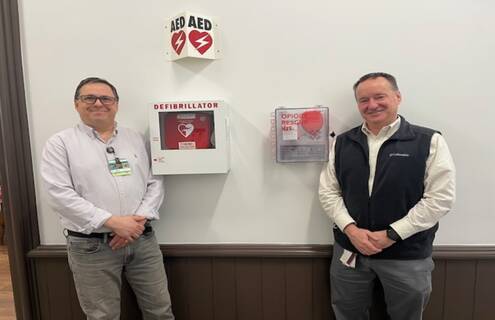
John Letendre, continuum of care facilitator for Cheshire Medical Center’s Center for Population HealthCheshire Medical Center, a member of Dartmouth Health, is helping increase access and awareness to naloxone by distributing opioid rescue kits to public organizations in the Greater Monadnock Region.
The New Hampshire State Opioid Response team equipped every public health network in the state, including Cheshire’s Center for Population Health, with these kits, known as NaloxBoxes.
NaloxBoxes hang on the wall, just as other emergency equipment like first aid kits or fire extinguishers would. The kit includes naloxone—a life-saving opioid overdose reversal medication, also known by the brand name Narcan—gloves, a face shield and instruction on how to properly administer the drug.
John Letendre, the continuum of care coordinator for Cheshire Medical Center’s Center for Population Health, has been in charge of distributing NaloxBoxes throughout the Monadnock Region, with 36 put up since the fall of 2023. The kits can be found locally in libraries, public housing authorities, universities and mental health organizations.
Ideally, the boxes would be used as often as any other emergency kit would. But having them in place is crucial, as opioid overdoses can quickly lead to death if no one intervenes.
In addition to saving more lives, these kits also help reduce the stigma often associated with opioid overdoses by treating these incidents like any other bystander-enabled medical response.
“Saving lives with naloxone is a critical part of harm reduction,” Letendre said. “People who die from accidental overdose do not get a second chance at recovery. Most people do recover eventually with help, support and treatment.”
Anyone, anytime, can experience addiction—and anyone, anytime, can ask for help. If you or anyone you know is experiencing an addiction, call 2-1-1. You will be connected with a Doorway at one of nine trusted community hospitals, including Cheshire Medical Center, depending on your location. The Doorway will connect you to the supports and services and the level of care that's right for you. To learn more, visit cheshiremed.org/doorway.
About Cheshire Medical Center
Cheshire Medical Center (Cheshire) advances the health and wellness of individuals across New Hampshire’s Monadnock Region through outstanding care and exceptional service. Cheshire teams deliver an impressive range of clinical services that support the community's needs. As a member of Dartmouth Health, Cheshire is able to provide services far exceeding those of a typical rural hospital, including extensive programs in primary care, cancer care, cardiology, orthopaedics, and public health. Cheshire patients are also able to access hundreds of highly trained specialists and a depth of clinical and technical resources through its collaboration with Dartmouth Health. Cheshire’s clinical practice is distinguished by an exceptional staff, a strong commitment to safety and quality, and a culture that values the contribution of every staff member and volunteer. Cheshire is the area's largest healthcare provider and leading employer. Along with the services delivered on their Keene campus and satellite locations, the Medical Center partners with local organizations to provide vital services and programs throughout the region. To learn more, call 603-354-5400 or visit cheshiremed.org.
About Dartmouth Health
Dartmouth Health, New Hampshire’s only academic health system and largest private employer, serves patients across New England. Dartmouth Health provides access to more than 2,300 providers in nearly every area of medicine, delivering care at its flagship hospital, Dartmouth Hitchcock Medical Center (DHMC) in Lebanon, NH. Its network of hospitals, outpatient centers, clinics and home care facilities, spans a broad geographical area. Year after year, DHMC is named the #1 hospital in New Hampshire by U.S. News & World Report, and is consistently recognized for high performance in numerous clinical specialties and procedures. Dartmouth Health includes Dartmouth Cancer Center, northern New England’s only National Cancer Institute-designated Comprehensive Cancer Centers and one of less than than 60 total nationally; Dartmouth Health Children’s, which includes the state’s only children’s hospital, the Golisano Children's Hospital at Dartmouth Health, and more than 20 locations around the region; eight member hospitals in Lebanon, Keene, Claremont, Hampstead, and New London, NH, and Windsor and Bennington, VT; Dartmouth Health Home Care; Dartmouth Health Connected Care Center for Telehealth, serving patients as far away as Texas; and more than 30 primary and multi-specialty clinics across New Hampshire and Vermont. Through its partnership with Dartmouth College, Dartmouth’s Geisel School of Medicine and the White River Junction VA Medical Center, Dartmouth Health trains nearly 400 medical residents and fellows annually and performs cutting-edge research and clinical trials with international impact. Dartmouth Health and its more than 16,000 employees are committed to serving the healthcare needs of everyone in the communities it serves and to providing every patient with exceptional, state-of-the-art, personalized care. Learn more at dartmouth-health.org.