
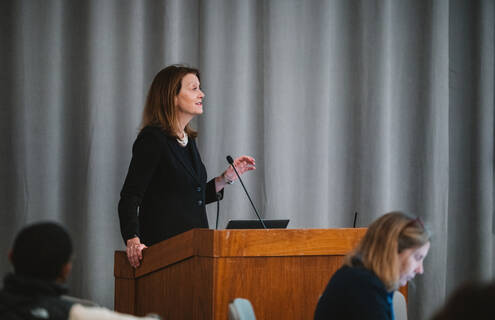
The second annual Dartmouth Rural Health Symposium convened on May 13 at the Hanover Inn with a sobering introduction.
“Rural populations are older, sicker, less educated and poorer, and have more difficulty accessing healthcare services, and die younger, than urban counterparts,” Mark A. Creager, MD, a cardiologist at Dartmouth Hitchcock Medical Center and program director of the Center for Rural Health Care Delivery Science told a standing-room only gathering of several hundred researchers, clinicians, policymakers, educators, and community members.
Steven Leach, interim dean of the Geisel School of Medicine and former director of the Dartmouth Cancer Center, further underscored the enormity of the problem, and its inherent inequity: “It’s axiomatic to say that in a just society, where you live shouldn’t determine how long or how well you live.”
“In our country,” he added, “20% of our population—65 million people—live in a formally designated rural area. That accounts for more than 80% of U.S. land mass. And yet, in spite of the breadth of our rural communities, folks who live in rural America live, on average, 3 to 4 years shorter than those who live in urban or suburban America.”
“It’s a problem of such complexity,” Leach said, “I would maintain that it’s only a place like Dartmouth that can solve it.”
Indeed, the symposium was held at a moment when Dartmouth President Sian Leah Beilock has declared rural health and society a research priority across the institution’s undergraduate and graduate schools and programs, including in partnership with, as Leach put it, “Dartmouth Health’s extensive network providing care for folks in rural and deeply rooted communities in Northern New England.”
This year’s forum—an initiative of Geisel, Dartmouth Health, and the Dartmouth Institute for Health Policy and Clinical Practice—was a sequel of sorts to Dartmouth’s first rural health symposium, which was held last May.
Under the headline “Transforming Rural Healthcare: Research-Driven Solutions, Real-World Impact,” this year’s discussion was framed by the systemic and structural barriers that contribute to rural health disparities, as well as the impact a range of factors can have on the health and wellness of residents of rural communities. They include:
- Shortages of healthcare workers
- The fraying mental health of those caregivers
- Challenges to transportation
- Families’ financial hardships
- Threats to federal resources
- Spotty internet access
- The precarious sustainability of some rural hospitals.
But threaded throughout the plenary and breakout sessions was a common theme: the lack of trust that residents of rural communities sometimes feel, including toward basic science, scientists, policymakers, elected officials, and the strained healthcare delivery systems that often seem, at least to them, engineered to enhance and extend the lives of those who live in cities and other more densely populated parts of the country.
“The truth is that the vast majority of Americans are deeply, deeply grateful to science,” said Amber E. Barnato, MD, MS, MPH, a palliative care specialist at Dartmouth Hitchcock Medical Center and director of the Dartmouth Institute. “But when you start drilling down on the people who are in the minority, who actually have some mistrust or are not supportive of investments, it turns out one of the reasons is because they feel they are not going to get access to those innovations.”
“Those groundbreaking, path-breaking innovations that we lead here in our healthcare delivery system through research are things that can save lives and improve quality of life,” she said. “But many people feel like they are never going to be able to get them. So it’s kind of unfair.”
Among the presenters offering pathways to potential solutions was Brendan Nyhan, the James O. Freedman Presidential Professor and a professor of government at Dartmouth. Nyhan, who studies public opinion, including the growing fissures between Democrats and Republicans regarding the efficacy and safety of vaccines, said that critical to regaining common ground on the issue is “for folks to hear from people on their side of the aisle that the vaccines they’re being offered are safe and effective.”
Nyhan also struck something of a hopeful note.
“It’s still the case that the vast majority of folks have confidence in vaccines,” he said. “This is not something where the battle has been lost. I think people are sometimes so attuned to threat and risk that they hear about the worst things that are happening, the most concerning updates every day, and it can feel like the sky is falling.”
“But actually,” he added, “while there’s reason for concern, it’s still the case that there is this strong overall level of support,” and that support should lay “the foundation for building back consensus.”
Lauren Taylor, of the NYU Grossman School of Medicine, led a group session examining the role of trust in improving rural health outcomes. She discussed the long-term decline in public trust in government and healthcare institutions, emphasizing that trustworthiness and trust are not always synonymous.
“Trust is nice to have but hard to measure,” Taylor said.
Panelists also highlighted the importance of listening to communities and recognizing how people’s experiences shape their perceptions of healthcare systems. “Trust is not built when institutions speak louder,” said Tanisha Johnson, executive director and co-founder of Black Lives Matter NH. “Trust is built when institutions listen better.”
Throughout the day, speakers emphasized that improving rural health outcomes requires not only medical innovation, but broad, authentic, intentional, and strategic collaboration.
Speaking in her capacity as chief executive officer and president of Dartmouth Health, Joanne M. Conroy, MD, pledged the organization’s ongoing partnership to rural communities and those who live there.
“Hospitals cannot solve the social drivers of health problems alone. Hospitals and health systems must be part of the solution,” said Conroy. “We are deeply woven into the fabric of our communities. We are not bystanders. And that’s why we’re here today.”
About Dartmouth Health
Dartmouth Health, New Hampshire’s only academic health system and largest private employer, serves patients across New England. Dartmouth Health provides access to more than 2,300 providers in nearly every area of medicine, delivering care at its flagship hospital, Dartmouth Hitchcock Medical Center (DHMC) in Lebanon, NH. Its network of hospitals, outpatient centers, clinics and home care facilities, spans a broad geographical area. Year after year, DHMC is named the #1 hospital in New Hampshire by U.S. News & World Report, and is consistently recognized for high performance in numerous clinical specialties and procedures. Dartmouth Health includes Dartmouth Cancer Center, northern New England’s only National Cancer Institute-designated Comprehensive Cancer Centers and one of less than than 60 total nationally; Dartmouth Health Children’s, which includes the state’s only children’s hospital, the Golisano Children's Hospital at Dartmouth Health, and more than 20 locations around the region; eight member hospitals in Lebanon, Keene, Claremont, Hampstead, and New London, NH, and Windsor and Bennington, VT; Dartmouth Health Home Care; Dartmouth Health Connected Care Center for Telehealth, serving patients as far away as Texas; and more than 30 primary and multi-specialty clinics across New Hampshire and Vermont. Through its partnership with Dartmouth College, Dartmouth’s Geisel School of Medicine and the White River Junction VA Medical Center, Dartmouth Health trains nearly 400 medical residents and fellows annually and performs cutting-edge research and clinical trials with international impact. Dartmouth Health and its more than 16,000 employees are committed to serving the healthcare needs of everyone in the communities it serves and to providing every patient with exceptional, state-of-the-art, personalized care. Learn more at dartmouth-health.org.
About the Geisel School of Medicine at Dartmouth
The Geisel School of Medicine at Dartmouth, founded in 1797, strives to improve the lives of the communities we serve through excellence in learning, discovery, and healing. The nation's fourth-oldest medical school, the Geisel School of Medicine has been home to many firsts in medical education, research and practice, including the discovery of the mechanism for how light resets biological clocks, creating the first multispecialty intensive care unit, the first comprehensive examination of U.S. health care cost variations (The Dartmouth Atlas), and the first Center for Health Care Delivery Science, which launched in 2010. As one of America's top medical schools, Dartmouth's Geisel School of Medicine is committed to training new generations of physician leaders who will help solve our most vexing challenges in health care.