

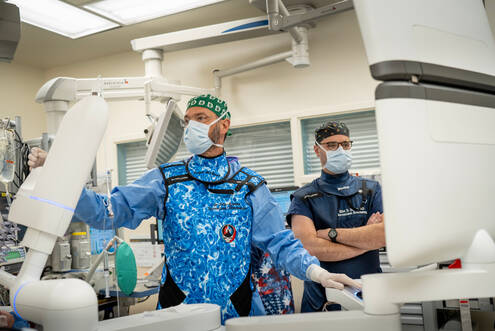
Dartmouth Health’s interventional pulmonology team has seen an increase in successful lung biopsy procedures over the past year, in part, due to their use of robotic bronchoscopy. The measurement of successful biopsy, known as diagnostic yield, is higher at Dartmouth Health than the national average. This is key to improving patient outcomes since detecting lung cancer early through yearly screening can reduce lung cancer-related mortality rates by 20 percent.
The robotic platform is often used instead of a computed tomography (CT)-guided needle biopsy, which can be a higher risk procedure in some patients. The robotic technology enables specialists to biopsy patients with smaller pulmonary nodules (rounded growths in the lungs) than was previously possible. This means physicians are more likely to catch cancer earlier and begin treatment sooner, which can make a significant improvement in a patient’s prognosis. Biopsying a lung nodule bronchoscopically also allows for the sampling of lymph nodes in the chest (known as “staging”) during the same procedure. Staging is considered a critical step in the care of patients with lung cancer.
“The chances of finding and sampling a small nodule in the lung are better than perhaps ever before,” said Elliot D. Backer, MD, Director of Interventional Pulmonology at Dartmouth Health’s Dartmouth Hitchcock Medical Center (DHMC). “Before adopting the robotics platform, this was very hard to do. Now, we can more safely and more accurately diagnose patients at an earlier stage than was previously possible.”
When Dartmouth Health adopted robotic bronchoscopy in April 2022, it was the first in New Hampshire or Maine to do so. The Interventional Pulmonology team has performed more than 200 procedures using the platform since then.
“One of the many benefits of being an academic health system means Dartmouth Health is at the forefront of the latest procedures, technologies and treatments,” said David J. Feller-Kopman, MD, Section Chief of Pulmonary and Critical Care Medicine at DHMC. “That can make a big difference when it comes to patient outcomes.”
As part of the multidisciplinary Comprehensive Thoracic Oncology Program (CTOP) at Dartmouth Cancer Center, Backer and Feller-Kopman are New Hampshire’s only interventional pulmonologists. These specially trained pulmonologists can use the robotic platform to navigate a patient’s airway through the throat with a 3.5-mm-diameter catheter, guided by a small camera and a three-dimensional map of the lung created from a CT scan. Once they locate the nodule of interest, a biopsy needle is fed through the catheter to retrieve the tissue. When a diagnosis is made, a patient’s case is reviewed by Dartmouth Health’s thoracic surgeons and cancer specialists to provide prompt, state-of-the art, multidisciplinary care.
Catching lung cancer early is critical for treatment, but not enough people are undergoing lung cancer screening. According to the American Lung Association, only about 11 percent of those at high risk for lung cancer were screened in New Hampshire in 2021.
Visit the Dartmouth Cancer Center website to learn more about the importance of early detection, and find out if you might be eligible for an insurance-covered early lung screening.
About Dartmouth Cancer Center
Since 1972, Dartmouth Cancer Center (DCC) has combined groundbreaking and advanced cancer research at Dartmouth and the Geisel School of Medicine with award-winning, personalized, compassionate, patient-centered cancer care and clinical trials. At its flagship location at Dartmouth Health’s Dartmouth Hitchcock Medical Center, with 14 locations across New Hampshire and Vermont, DCC is one of fewer than 60 National Cancer Institute-designated Comprehensive Cancer Centers nationally. Each year, DCC manages 74,000 appointments, treats more than 4,500 newly diagnosed patients, and currently offers more than 240 active clinical trials. DCC remains committed to excellence, outreach and education. DCC strives to create new knowledge and impact, accelerate integrated and collaborative research to prevent and cure cancer, enhance survivorship and promote cancer-related health equity. Learn more at cancer.dartmouth.edu.
About Dartmouth Health
Dartmouth Health, New Hampshire’s only academic health system and largest private employer, serves patients across New England. Dartmouth Health provides access to more than 2,300 providers in nearly every area of medicine, delivering care at its flagship hospital, Dartmouth Hitchcock Medical Center (DHMC) in Lebanon, NH. Its network of hospitals, outpatient centers, clinics and home care facilities, spans a broad geographical area. Year after year, DHMC is named the #1 hospital in New Hampshire by U.S. News & World Report, and is consistently recognized for high performance in numerous clinical specialties and procedures. Dartmouth Health includes Dartmouth Cancer Center, northern New England’s only National Cancer Institute-designated Comprehensive Cancer Centers and one of less than than 60 total nationally; Dartmouth Health Children’s, which includes the state’s only children’s hospital, the Golisano Children's Hospital at Dartmouth Health, and more than 20 locations around the region; eight member hospitals in Lebanon, Keene, Claremont, Hampstead, and New London, NH, and Windsor and Bennington, VT; Dartmouth Health Home Care; Dartmouth Health Connected Care Center for Telehealth, serving patients as far away as Texas; and more than 30 primary and multi-specialty clinics across New Hampshire and Vermont. Through its partnership with Dartmouth College, Dartmouth’s Geisel School of Medicine and the White River Junction VA Medical Center, Dartmouth Health trains nearly 400 medical residents and fellows annually and performs cutting-edge research and clinical trials with international impact. Dartmouth Health and its more than 16,000 employees are committed to serving the healthcare needs of everyone in the communities it serves and to providing every patient with exceptional, state-of-the-art, personalized care. Learn more at dartmouth-health.org.